-
Burglary is Not a Non-Violent Crime: In Oakland, It Isn’t Even a Crime
Posted on July 27th, 2010 No commentsWell, OK, that’s not exactly true. But in July, Oakland police announced that, due to budget problems, police will no longer respond to a long list of crimes, including residential burglary where the home invaders are unknown.
I’m sure it didn’t help that the city had to spend so much money responding to the recent liberation of sports shoes and consumer electronics in the name of Oscar Grant.
Shoe Locker Looter Wearing an Oscar Grant Mask
That’s a lot of money that could be spent on doing things like protecting people’s property, going instead to prevent protesters from destroying even more Mom and Pop franchises and delis and phone kiosks and other symbols of oppression.
Maybe there should be an enhanced penalty for premeditated rioting.
Meanwhile, want to train to become a burglar? Move to Oakland. Though I don’t recommend living there, because home insurance rates are about to shoot up. For everyone, of course, not just burglars and looters. Funny how that works.
I spent way too much time yesterday fruitlessly searching for a comment I’d seen on a police blog, one that perfectly sums up the dangers of lowering the bar on criminal behavior this way. The commenter, a cop himself, was writing about the war on cops. He pointed out that virtually every cop killer has repeatedly cycled through the court system, learning along the way that he could get away with practically anything.
Even more troubling, the widespread belief that so-called non-violent crimes like drug trafficking and residential burglary don’t merit prison terms is creating a generation of criminals who not only have no fear of consequences but actually feel entitled to commit crimes. Whenever they find naive people to support them in their belief in these “rights,” they also feel more entitled to direct their resentment and rage at symbols of law enforcement, namely cops.
We should not underestimate the perniciousness of reinforcing the notion that it is “unjust” to punish people for things like breaking into other people’s houses.
Oakland has actually codified that mindset.
These trends are especially dangerous for women. Back when Georgia was implementing its DNA database by collecting DNA from all felons, not just sex offenders, something really shocking showed up in the first few hundred “hits” (where a felon’s sample matched previously unsolved crimes). Many men who only had prior records for burglary or drugs or aggravated assault were identified as rapists in stranger rapes that had gone unsolved.
That begs a few questions, questions which, sadly, law professors and criminologists are utterly disinterested in asking. Too bad, because they’re extremely relevant in the ongoing debate about prosecuting or not prosecuting certain crimes and how we choose to spend our shrinking justice budgets.
For example, how many of these men were previously caught committing rapes but were granted non-sex offense pleas by money-conscious prosecutors who didn’t think they could get rape charges to stick? In one of his several trips to prison, my own rapist got more time for resisting arrest and B&E than for sexually assaulting another victim — more time for breaking into a window than a woman’s body — thanks to one such money-saving plea. I’ve got a file cabinet stuffed with other examples of serial rapists — and serial killers — given multiple chances to rape and kill, thanks to routine, money-saving courtroom shortcuts.
They don’t call them “bargains” for nothing. These types of offenders also now have enhanced abilities to do pre-assault dry runs in Oakland and other places that are ratcheting back law enforcement.
Now, with less enforcement of these lesser crimes, more serious offenders stand to get away with even higher quantities of violent crime. A sex offender operating in Oakland can rest confident knowing that the police won’t be showing up to investigate his fishing expeditions. Does anybody believe the that the tiny fraction of burglars who end up in a courtroom in Oakland won’t benefit from the downgrading of this crime?
And what is happening in Oakland is the future for everyone, the logical consequence of decades of pricing justice out of reach — for us non-offenders, that is. We spend so much on largely useless “rehabilitation” and frivolous appeals that there is no money left to actually enforce the law. This is how violent recidivists are made, and how cops get killed, and why the rest of us are forced to spend more and more of our money insuring our lives and looking over our shoulders.
In the 1990’s, elected officials were able to turn New York City around by doing precisely the opposite of what Oakland is doing today. Expect opposite results, as well.
-
Michael Harvey, “Mr. X,” Guilty of Murder. Now, Where Was He From 2005 – 2008? 1999 – 2003? 1985 – 1998?
Posted on April 14th, 2010 No commentsMichael Harvey is now the third man found guilty of one or more murders of prostitutes and other women in southeast Atlanta in the early 1990’s. As I wrote last week (see here and here), the state missed at least two earlier chances to link Harvey to that crime and get him off the streets: once in 2003, when they were supposed to have taken DNA from him before he left prison for another sex crime, and again in 2005, when they (apparently) got around to testing his DNA and linked it to the murder of Valerie Payton — but then failed to charge him for three more years.
OK folks, the trial is over. When is somebody going to ask the GBI, and Fulton County D.A. Paul Howard, why it is that the rape kit of a women murdered by a probable serial killer, and a DNA sample they could have obtained as early as 1996?
You don’t just wake up one day and stab a woman fifty times, arrange her body for display, and leave a note on her stomach taunting the police — written on the back of a photo of her 8-year old child. Talk about a crime that cries out for justice — and indicates other victims. In fact, Harvey has another sex crime conviction, and a third victim testified at his trial that he raped and threatened to kill her around the same time Payton was murdered.
One would think the GBI would have prioritized getting Payton’s rape kit tested, and maybe they did — or maybe they didn’t. Maybe the APD never sent the rape kit to them. Maybe it’s all the fault of the Fulton County D.A., which had the ability to push for DNA testing when Harvey was convicted for another sex crime and kidnapping in 1996 (got a mild slap on the wrist). DNA had been used to convict sex offenders for a decade by then. Rape and kidnapping had been clearly identified as a social ill, too, though his sentence hardly reflected that. Maybe it’s the fault of the Department of Corrections, which released Harvey in 1999, by which time they should have been databasing the DNA of all felons convicted for sex crimes. Certainly, by 2003, Harvey was required by law to give a sample, when he served time for an aggravated assault. Why wasn’t he identified then?
Where was Michael Harvey between November 1985 and May 1998, after he already had a record, before he was first arrested for a sex crime? Where was he between September 1999 and February 2003, after he was convicted of one sexual assault, sternly scolded for a whole 16 months, then cut loose again? Where was he between June 2003 and his arrest in 2008 for the murder he was linked to in 2005?
Where was he in 2005, when he was identified as Valerie Payton’s murderer but not officially charged for three more years?
Somebody screwed up. Why does nobody care?
-
Mr. X: Did the State of Georgia Let a Serial Killer Go?
Posted on April 6th, 2010 4 commentsSome mornings, it’s pitifully easy to find something to write about.
Like, this morning. Back in the early 1990’s, a serial killer was stalking women in the Reynoldstown neighborhood in Atlanta. Reynoldstown was, in all senses of the term, crack-infested. There were a lot of drug-related deaths. There were a lot of prostitutes: the two go hand in hand. Men from all over metro Atlanta would drive there to get an extremely cheap woman, or girl. Or boy, I imagine. This was precisely the same area where little boys were disappearing during the Atlanta Child Murders in the 1980’s. It wasn’t a very long walk to some of the body dump sites.
I lived a few blocks east, in Cabbagetown. On Fridays, I avoided gardening in my front yard because the men with Cobb County plates were trolling the streets, picking up emaciated prostitutes. Some of the prostitutes jerked and twitched as they walked from cocaine-induced tardive dyskinesia. Anyone who believes prostitution is a victimless crime is an intellectual buffoon. The wives of the Johns were certainly victims. There was a mother-daughter team jumping in and out of cars on my street corner: the daughter didn’t wear shoes. She looked like she weighed about 75 pounds. Her arms and legs were a constellation of bruises and sores. What were those old men from the suburbs thinking? She could be their granddaughter. She was visibly sick.
By 1990, when I moved in, Wayne Williams had been sitting in prison for nearly a decade. The cameras had gone elsewhere, and the money, too: politicians like Maynard Jackson and Arthur Langford (curious story, that) had sucked up the cash decent people sent to Atlanta to help the murder victims and long ago moved onto the next gravy train. Eight female prostitutes dead in Reynoldstown didn’t attract much attention outside the police, who, contrary to stereotype, were actually the only people who gave a damn about the deaths. Police, relatives, and local people — they knew who had children, and who went missing, and who had been a nice teenager before she got hooked on drugs. On the other side of town, both female and transvestite male prostitutes were getting killed. The transvestites were getting shot in the head: the women were mainly strangled or beaten to death. If I remember correctly, if this particular murder didn’t occur later, one of the female victims was found strung up from a tree in a graveyard. I went looking for more information about the transvestite killings and found only this blog post by “atl-Steve,” who lists nine of the Atlanta transvestite murders, eight between 1990 and 1992, seven shot in the head. There were probably several serial killers preying on people in Atlanta at that time. The drugs and the prostitution gave them extremely easy access to victims. Life was extremely cheap.
One of the stories that circulated was about a Mr. X: in 1994, a woman’s body was found with a note that said: “I’m back in Atlanta, Mr. X.” The woman was a prostitute, and she had been strangled. This morning, in the Atlanta Journal Constitution, there is a story about the upcoming trial of Michael Harvey, who is linked to her murder through DNA.
That’s where the story stops making sense.
The newspaper is reporting that Michael Harvey was linked to the murder through DNA in 2005 and arrested in 2008. It isn’t clear why it took three years to arrest him. Was he on the run? Was he being held on other charges? It doesn’t say. But it seems to me that if the police had been looking for him all this time, somebody would have said that. And if he had been in custody in Fulton county pending charges after the DNA match, somebody would have said that.
Because the alternative is so extremely disturbing. The alternative is that Michael Harvey was identified as a murderer, likely a serial killer, in 2005, and then nobody did anything about it for three years. In the age of DNA, that can’t possibly be true, can it? I hope I am missing something here.
Since 2000, all felons sentenced to state prison in Georgia have had to provide DNA samples to the state, to be added to a DNA database. That law was passed thanks largely to recently deceased feminist activist Vicki McLennon and Lt. Governor Mark Taylor, and it has solved many sex crimes and saved lives.
In 2002 or 2003 (it isn’t clear from the state database), Michael Harvey was convicted of an aggravated assault in Fulton County. The crime occurred August, 2002. He was sentenced to six months and spent February to June, 2003, in state prison. At that time, he should have given the state a DNA sample. He also had a prior false imprisonment and attempted sexual assault conviction on his record. Wouldn’t the DNA from anyone with a sexual assault conviction be carefully checked for other sexual assaults? In any case, if the law was followed, Harvey gave the state a DNA sample no later than June 2003. His DNA was matched to a stranger serial murder in 2005. He was charged with that murder in 2008.
So somebody has some questions to answer:
- If he was in fact released, why was Michael Harvey, a convicted sex criminal, released from prison in 2003 without his DNA sample being entered into the state database?
- Why wasn’t he arrested and charged with murder in 2005, when the GBI linked his DNA to a serial murder?
- Why did it then take three more years to charge him with the crime? Is this a screw-up that should be laid at the feet of Fulton County District Attorney Paul Howard?
And some larger questions:
- Was he really convicted only of aggravated assault in 2002/3, or was that a sex crime charge pled down to mere assault by some willing prosecutor and judge? Were any other convictions actually sex crimes that got pled down, too?
- Why did Michael Harvey get only three years for attempted rape and false imprisonment in 1996? Three years for trying to rape a woman? Nice.
- Why didn’t the state of Georgia bother to take a DNA sample from Harvey when he was convicted of rape in 1996? DNA was being widely used by then, and as a sex offender, Harvey probably had to provide a sample, even though the state law requiring DNA of all felons had not yet been passed. Did he give the state DNA? Why wasn’t it tested, if it wasn’t tested? Is that sample one of the thousands shelved and forgotten by a criminally careless criminal justice system?
- Does Michael Harvey’s DNA match any other crimes, especially crimes committed since the state last cut him loose?
Here is Harvey’s prior conviction record:
CASE NO: 130362OFFENSE: NOT AVAILABLE
CONVICTION COUNTY: CONVERSION
CRIME COMMIT DATE: N/A
SENTENCE LENGTH: NOT AVAILABLECASE NO: 130362OFFENSE: NOT AVAILABLE
CONVICTION COUNTY: CONVERSION
CRIME COMMIT DATE: N/A
SENTENCE LENGTH: NOT AVAILABLECASE NO: 130362OFFENSE: BURGLARY
CONVICTION COUNTY: FLOYD COUNTY
CRIME COMMIT DATE: N/A
SENTENCE LENGTH: 2 YEARS, 0 MONTHS, 0 DAYSCASE NO: 130362OFFENSE: THEFT BY TAKING
CONVICTION COUNTY: FLOYD COUNTY
CRIME COMMIT DATE: N/A
SENTENCE LENGTH: NOT AVAILABLECASE NO: 130362OFFENSE: THEFT MOTORVEH OR PART
CONVICTION COUNTY: FLOYD COUNTY
CRIME COMMIT DATE: N/A
SENTENCE LENGTH: NOT AVAILABLECASE NO: 130362OFFENSE: THEFT MOTORVEH OR PART
CONVICTION COUNTY: FULTON COUNTY
CRIME COMMIT DATE: N/A
SENTENCE LENGTH: 6 YEARS, 0 MONTHS, 0 DAYSHe spent four years behind bars for these crimes, October 1980 to November 1984. A long time for motor vehicle theft. And that burglary: was it really just burglary?
CASE NO: 176538OFFENSE: NOT AVAILABLE
CONVICTION COUNTY: CONVERSION
CRIME COMMIT DATE: 09/07/1984
SENTENCE LENGTH: NOT AVAILABLECASE NO: 176538OFFENSE: CRMNL INTERFERE GOVT PROP
CONVICTION COUNTY: HABERSHAM COUNTY
CRIME COMMIT DATE: N/A
SENTENCE LENGTH: 1 YEARS, 0 MONTHS, 0 DAYSCASE NO: 176538OFFENSE: simple battery
CONVICTION COUNTY: HABERSHAM COUNTY
CRIME COMMIT DATE: N/A
SENTENCE LENGTH: NOT AVAILABLEHe appears to have served nine months for these crimes, February to November 1985. Then the Atlanta killings began.
CASE NO: 392286
OFFENSE: FALSE IMPRISONMENT
CONVICTION COUNTY: FULTON COUNTY
CRIME COMMIT DATE: 08/08/1996
SENTENCE LENGTH: 3 YEARS, 0 MONTHS, 0 DAYSCASE NO: 392286
OFFENSE: AGG ASLT W INTNT TO RAPE
CONVICTION COUNTY: FULTON COUNTY
CRIME COMMIT DATE: 08/08/1996
SENTENCE LENGTH: 3 YEARS, 0 MONTHS, 0 DAYSCASE NO: 392286
OFFENSE: AGG ASLT W INTNT TO RAPE
CONVICTION COUNTY: FULTON COUNTY
CRIME COMMIT DATE: 08/08/1996
SENTENCE LENGTH: 3 YEARS, 0 MONTHS, 0 DAYSHe appears to have served 1 year, 4 months in state custody for this crime, from May 1998 to September 1999. He probably served some of his sentence in county custody prior to being transferred to state prison. But his DNA, if it was sampled, was never checked against other rape and rape-murder cases in Fulton County while they still had him behind bars. Come on, folks: 1999? Unsolved rape-murders? There’s no excuse.
CASE NO: 515573OFFENSE: AGGRAV ASSAULT
CONVICTION COUNTY: FULTON COUNTY
CRIME COMMIT DATE: 08/18/2002
SENTENCE LENGTH: 0 YEARS, 6 MONTHS, 0 DAYSHe served February – June 2003 in state custody for this crime.
2005: Harvey’s DNA is matched to the 1994 murder of Valerie Payton.
2008: Harvey is charged with Valerie Payton’s murder.
~~~
“I’m Back in Atlanta. Mr. X.”
Living in Cabbagetown in the early 1990’s gave me a front-seat view of the realities of prostitution. Not that they’re particularly difficult to discern from further distances. Ironically however, just a few years later, I entered graduate school and found that academic feminists had a very different attitude towards what they euphemistically termed “sex work.”
While real feminists were pounding the halls of the Georgia legislature and city officials to strengthen laws against rapists, child molesters, and pimps who targeted children (Mayor Shirley Franklin’s finest legacy), many of the academic feminists I met were busy “celebrating” prostitution as a “liberatory practice.”
So, in a city where scores of prostitutes, including children, suffered addiction, disease, violence, rape, and murder as a direct consequence of their “careers,” the academics were excitedly playing at being fake prostitute labor organizers and paying fake professional “sex workers” like the repugnant Dolores French to come titillate them with trumped up stories about happy hookerdom. French is married to defense attorney Michael Hauptman, who used to specialize in getting violent child molesters off (his e-mail name is loophole) — sort of a two-fer for those whose outrage over date rape never bled over into actually advocating for harsher sentencing for any rapists.
The distance between Valerie Payton’s murdered body and this dismal intellectual buffoonery? Four miles, or a thousand light years. Take your pick. Meanwhile, I hope somebody in Atlanta will get to the bottom of Michael Harvey’s story. Nothing is particularly clear right now.
-
Thanks to Modern Sex Offender Registries and DNA Databases, A Rodney Alcala Would Not Succeed Today
Posted on April 5th, 2010 1 commentToday, the lead story on all my local news stations was about a Schizu named Tuchi who saved his family from a house fire by barking incessantly at the flames. Dog-saves-family-from-fire stories are always popular.
Not so popular, at least to the media? Stories about how registering sex offenders saves lives. There is only one story to be told about sex offender registries, according to the fourth estate, and that story is how registries viciously destroy men’s lives when all they did was commit one little sex crime and must now live forever under the cold eye of the state.
The corrective to such thinking is always just under the reporters’ noses, but most never seem to suss it out. Rodney Alcala is one such corrective, but once you get past the fact that Alcala has a giant IQ and funny hair and was once a contestant on The Dating Game, the media (with one significant exception) seems to have lost interest in any lessons that might be learned from his long and shocking criminal career.
For the L.A. Times, studied incuriosity is understandable: after all, they literally allowed Alcala to operate under their noses — in their offices — after he’d racked up an incredibly horrifying, publicly recorded sex crime record. I’d be busy changing the subject, too.
But what about everyone else? Alcala is a poster boy for the efficacy of registering sex offenders and other demonstrably violent criminals. Here is a guy who went from raping and trying to murder an 8-year old in California to working as a camp counselor in New Hampshire while spending weekends in New York killing socialites. Sure, he did it under an assumed name, but when you combine fingerprinting and national registries and DNA database sharing, you come up with a pretty compelling explanation for the sharp reduction in sex crimes over the past twenty years.
And when you don’t bother to do these things right, what you get is a trail of raped and murdered women, from places like Venice (Florida) to Bradenton, precisely where I once tried, and failed, to prevent a similar trail of women’s bodies, eighteen years ago.
Things are better today. But they won’t stay that way if we don’t recognize and acknowledge innovations that have actually lowered the crime rate. Powerful, well-funded, pro-offender activist groups are always working to roll back the clock on things like DNA databasing and minimum mandatory sentencing and three-strikes laws and sex offender registration, and, sadly, they’ve got most of the print media yipping their agenda like so many toy poodles.
-
Update on Delmer Smith: Another Murder By DNA Database Neglect
Posted on February 12th, 2010 3 commentsDelmer Smith (see The Guilty Project, here), who managed to get away with at least dozen extremely violent crimes before being identified because the F.B.I. didn’t bother to load his DNA into the federal database, is now being charged in the murder of Kathleen Briles. Dr. James Briles found his wife’s body in their home.
Kathy Briles, mother of three, would be alive today if the government and our criminal courts bothered to prioritize the lives of victims with half the vigilance they direct towards the rights of offenders. Pro-offender activists, who hammer away at every effort to monitor violent offenders who have been returned to the streets, are culpable too.
But nobody prioritizes victims, except the police. Victims remain expendable.
Here is Dr. Briles:
MANATEE — Dr. James Briles finally got the chance to focus his rage on someone Thursday, more than six months after finding his wife bound, gagged and beaten to death in a pool of blood in the living room of their Terra Ceia home.
Manatee Sheriff Brad Steube announced that Delmer Smith III — already charged with beating and raping several women in their Sarasota homes — has been served with a warrant charging him with murder in the death of Kathleen Briles on Aug. 3.
Detectives say Smith, 38, bludgeoned the 49-year-old woman to death with an iron antique sewing machine, before stealing several items from the house.
After Steube told a room full of media of Smith’s arrest, Dr. Briles spoke on behalf of his sons, Calvin and Curtis, and daughter Kristen Venema, saying Smith deserves “no quarter.”
“Let me say a little bit about Delmer Smith,” said Briles, who found his wife’s body after returning home from work. “He is a coward, a sociopath and a punk. His sole purpose is to inflict suffering.”
Briles said Smith is not only in jail to protect the public from him, but to “protect him from us.” He spoke of his anger, and the horrifying discovery of his wife.
“Am I angry? Oh yeah,” he said. “You’d understand that if you saw what I saw when I came home.”
Good for him. He’s got every right to be angry:
Investigators also believe Briles’ death might have been avoided, if not for a backlog in the entry of DNA samples into an FBI database.
The FBI had Smith’s DNA, taken while he was in federal prison on a bank robbery conviction. But since it had not been entered into the database, there was no match when Sarasota detectives last spring submitted evidence from four earlier home invasion attacks.
There wasn’t a match until after Smith was arrested for a bar fight in Venice, and after detectives asked the FBI to enter his DNA into the database.
And after Kathleen Briles was dead.
More coverage.
Part of the story here is police performance. The cops came through when federal parole agents did not. Venice Captain Tom McNulty (who also helped put my rapist away for good, after various judges and parole officials cut him serial breaks for two decades), was among investigators in two counties who made the cognitive leap to tie Smith to the home invasion crimes and hold him pending DNA analysis — after Smith was arrested in an unrelated bar fight.
Had that fight happened in any one of a thousand other jurisdictions, there is a good chance Smith would have walked away from jail and been free to keep committing crimes.
Delmer Smith is only one of several serial killers and rapists who have literally gotten away with murder thanks to lax sentencing, nonexistent parole, and failure to enforce DNA database laws — a systematic neglect of legal reforms that cost countless women their lives. There’s John Floyd Thomas, suspected of killing some 30 women in Los Angeles — his first rape conviction was in 1957. There’s Walter E. Ellis, who killed at least nine women, and managed to avoid detection because Wisconsin officials failed to bother to hold him responsible for submitting another inmate’s DNA as his own before releasing him from prison.
How many more Delmer Smiths are out there? One is too many.
-
East Coast Rapist, DeKalb County Rapist: Serial Rapists and DNA. It Works. If You Bother to Use It.
Posted on December 18th, 2009 No comments(Hat tip to Pat)
In 2007, I stood by the mailbox of the house I once briefly rented in Sarasota, Florida, contemplating the short distance between my house and the house where my rapist grew up, less than a mile, and a strikingly direct path over a well-worn shortcut across the train tracks.
I had just spent several months and many hundreds of dollars to get copies of the police investigation reports for my rape and some of the court records of the man who was accused of, but never prosecuted for the crime. Every time he was sent away on another sex crime conviction, the police closed all the other rape cases they attributed to him. In 1987 he was tried for one sexual assault, and at least six other cases were shelved, including mine.
Such was the economy of justice in 1987: rapes were not deemed important enough to expend the court resources to try every known defendant for every crime. This attitude arose not from the police but from the legal establishment and, by extension, the public. It was an accepted status quo, not just in Sarasota, but everywhere.
To behave as if each rape victim actually deserved justice and every woman deserved to be safe from offenders was not anybody’s priority for spending money in 1987. The same can still be said today, though attitudes have spottily improved. We’ve never spent enough money to thoroughly investigate and prosecute more than a fraction of all crimes.
Criminals know this, though the public remains largely oblivious.
I remember being astonished when the police told me the D.A. would not be prosecuting my case, even though there was evidence and a rape kit. A few months later, the first rape case in the United States using DNA evidence would be won in Orlando, a mere hundred miles and three jurisdictions away. There, the D.A. had decided to be aggressive and use this new technology already in use in Britain, and he succeeded. But more than a decade would pass before DNA evidence was even routinely collected and databased in most states.
A lot of people slipped through the cracks unnecessarily during that decade, including my rapist. Sentenced to 15 years for his 1997 crime, he walked out of prison seven years later, the beneficiary of both the state’s unwillingness to fully fund prisons and activists’ efforts to get every convict back onto the streets as quickly as possible. He immediately returned to raping elderly women, his preferred victims, and wasn’t back in prison until 1998. At least the prisoner activists, and the defense bar, were happy.
Before the statute of limitations ran out on my case, I had offered to return to Florida to testify against my rapist. to try to keep him behind bars for a longer period of time. The state had the ability to test the DNA in my rape kit. I hired a private detective and reached out to the then-current Sarasota County D.A. They practically laughed at me for having the audacity to suggest such a thing and said they didn’t have the money to go back and try old cases. So Henry Malone walked, and more elderly women were raped.
Have things changed, even now? Yes and no. Two serial rape cases in the news show both progress and stagnation.
The stagnation is in DeKalb County, Georgia, the eastern part of metro Atlanta. I know the area well: I worked there and lived nearby for much of two decades. A serial rapist is on a real tear in DeKalb, raping at least three women since October and possibly three more since the last week of September. Police officials told reporters that they had requested rush DNA tests on the three unknown cases from the state lab and were waiting for results. But when CBS News Atlanta went to the state lab to find out why the tests weren’t done yet, the head of the DNA testing unit told reporters that no such request had been made.
I’m generally sympathetic to the police — less so to police brass, who sometimes rise through the ranks due to politics, not professionalism (there are some great precinct sergeants in Dekalb County, though). But now that the mistake has been made, the executive command ought to be out in front, showing the public that they are serious about doing everything they can do, as quickly as they can do it, to catch this rapist. Six, or even three rapes in a few months is escalating behavior, and he threatens his victims with a gun.
Ironically, the police caught several other fugitives while searching for this rapist. It’s all about resources: we live knee-deep in wanted felons and under-investigated suspects, and our elected officials pretend that this is a perfectly normal way to live.
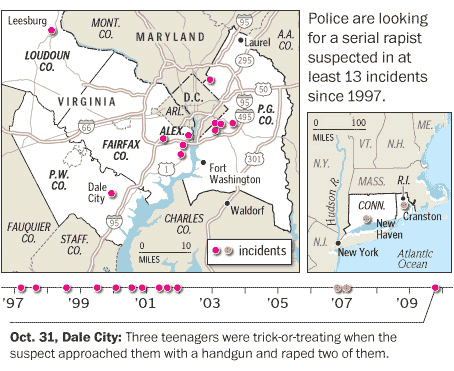
Meanwhile, police in the Washington D.C. area are using the media to appeal to the public to help them find the “East Coast Rapist.” There should be more publicity. This rapist has been active for at least 12 years: DNA tests reveal a pattern of travel between the D.C. suburbs, Connecticut, and Rhode Island during that time.
So there is a chance that somebody else knows the identity of the rapist because of his changing locations. Profilers used to assume that serial rapists and serial killers were loners, but this, like so many other presumptions (ie. serial killers are usually white men, serial offenders pick only one type of victim) have been proven to be false.
The Washington Post has an interactive map listing the locations and dates of the East Coast rapist’s attacks in today’s paper:
The rapist may have been in prison for some other crime between 2002 and 2007, and even 2007 and 2009. You have to figure that officials in Washington D.C., Connecticut, and Rhode Island have already submitted DNA to the national database, so if he had ever been convicted of a sex crime, or even served time for some other felony in most states, his DNA would be on record somewhere.But who knows? Maybe he was committing sex crimes in one of the many places where DNA samples don’t get processed properly, like Wisconsin and Michigan and California. Maybe he’s supposed to be behind bars but hasn’t been picked up yet because nobody is bothering to keep track of thousands of offenders who have absconded on bail, the situation in Philadelphia.
It’s all about resources. Twenty-two years after the first use of DNA in convicting a serial rapist, there should be no backlogs. Rape is too important. Thousands of offenders shouldn’t still be walking out of prison after skipping their DNA tests, through deceit or carelessness. Every one of these cases represents a denial of justice to someone.
Too bad criminal justice activists and law professors and university president-types don’t get all worked up when the person being denied justice is the victim, instead of the offender.
When I purchased the transcripts from some of Henry Malone’s many perambulations through the courts (and how nice that I had to pay, and pay a lot, for them), I was astonished to read the details of one hearing that was held at Malone’s behest because he demanded reimbursement for a fine related to his car, which had been impounded when he was arrested for sexual assault. The judge and the defense attorney seemed amused by his bizarre demand. I don’t find it so funny. Imagine what we paid for the judge to read that demand, for the lawyer to research the claim and represent Malone in court, for the court reporter, and the security guards, and everything else that went into assuring that Henry Malone would get to be heard in court over an inane and dismissible whim.
The same courthouse where I had been denied the chance to face Malone for raping me because nobody wanted to bother spending the money to try him for more than one rape. Criminals have rights the rest of us can’t dream of. It’s all about the resources, and every last dime goes to offenders; they get everything they want, whenever they want it, out of the courts, while their victims wait out in the cold.
-
Delmer Smith and the A.C.L.U.
Posted on October 9th, 2009 1 commentDelmer Smith is now either being investigated or charged in 11 attacks on women and one on a man that occurred after he left DNA at a crime scene in 2008. Had the FBI bothered to upload his DNA profile into their database in a timely manner, these 12 rape, murder, and assault victims would not be victims today. For, if the FBI had done its job, Smith would have been identified the first time he committed a sexual assault after release from prison, and police would have known where to find him because he also had to register his address with the parole board.
Looking beyond the FBI’s screw-up, this case illustrates the importance of probation and registration requirements and of laws that require all convicted felons to give samples of DNA.
If the system had been working as it was supposed to, Smith would have never gotten the chance to victimize so many people. Yet these DNA database laws are vehemently opposed by the A.C.L.U.
If the A.C.L.U. had its way, convicted felons like Delmer Smith would be able to keep committing crimes under the cover of anonymity, while police hands would remain tied. The police would be denied the very tools that are credited with significantly reducing the rate of rape in recent years. That’s thousands of rapes prevented by getting serial rapists off the streets.
The A.C.L.U. argues that the government can’t be trusted with sensitive information like DNA; they argue that ‘in the future, the database might get misused.’ They insinuate that medical information might be gleaned from the information in the database, which is just silly. They float accusations of potential racial profiling. They say anything, in other words, to try to inspire fear, in order to achieve their real goal, which is to block the enforcement of the law, by any means necessary, no matter the body count.
When you hear arguments about how unfair it is to force ex-cons to register with the state, or to keep their DNA on record for the next time they decide to rape an elderly woman or beat someone to death, think of Delmer Smith’s 11 victims. Good policing stopped Smith after bad administration of the federal DNA database slipped up. But this case illustrates precisely why the police need all the tools they can get.
No matter what the A.C.L.U. says.
-
DNA Could Have Stopped Delmer Smith Before He Killed, But Nobody Cared Enough To Update the Federal Database
Posted on October 6th, 2009 1 commentThis is Delmer Smith, who is responsible for a recent reign of terror on Florida’s Gulf Coast that left women from Venice to Bradenton terrified of violent home invasions, murder and rape:
Delmer Smith gave a DNA sample to the Feds 15 years ago, when he was incarcerated in Michigan on federal bank robbery charges. And then what did the Feds do? Well, in fairness, they were super busy not watching Phillip Garrido as he repeatedly raped and impregnated the child he was holding captive in his backyard.
So the feds apparently did nothing with Delmer Smith’s DNA. Now a slew of women have been raped, and at least one murdered, crimes that could have been easily prevented if the feds had done what they were supposed to do and entered Smith’s DNA into the appropriate database.
But they couldn’t be bothered, just like the states so often can’t be bothered, just like Florida couldn’t be bothered fifteen years ago when they let my rapist walk out of prison to commit more rapes of frail, elderly women because they didn’t bother to link him to other crimes using DNA from kits they were supposed to test, but didn’t.
In precisely the same neighborhoods Delmer just tore through: Sarasota, Venice, North Port.
This time, to be clear, it wasn’t the Florida courts that screwed up: it was federal authorities. Funny how they all screw up in precisely the same way, though: serial neglect of serial criminals who rape and kill again. How much do they screw up? Well, I’m understandably tuned in to this little piece of Florida’s West Coast, but it takes about fifteen minutes on Lexis-Nexus to find similar “mistakes” in every state. We are letting extremely violent criminals slip through the cracks, and nobody seems outraged about it: nobody seems to be trying to plug the many holes in the system, or even to try to figure out what those holes are.
~~~
What to do? Although police are usually the ones singled out when a serial offender is on the loose, their actions are rarely the reason recidivists are free. Blame the courts — from lax prosecutors to lenient judges, to the hash the defense bar has made of our criminal justice system. Also blame parole boards, and legislators and governors who refuse to fund prosecutions and prisons at realistic levels.
Finally, blame the activists who will do anything to get certain offenders out from behind bars, all the while banging the drum that “America is a prison state: we incarcerate too many people for too long. . .” Any cursory review of crime reports, arrests and convictions shows that precisely the opposite is true: we incarcerate too few people, and we let them go too soon.
People still routinely get a few months in jail for molesting a child, or probation for shooting someone. But how do we make this visible, when prosecutors and judges want to hide their actions, and reporters won’t report on it?
It’s Time for a “Guilty Project”
Failure to Update DNA Database
Delmer Smith: suspected in a dozen home invasions, several rapes, one or more murders, all thanks to the failure of federal authorities to enter his DNA profile in the CODIS database. Too bad the F.B.I. sent a profiler down to Florida tell the cops that the killer was probably a male with anger issues, instead of making sure CODIS (which is the FBI’s responsibility) was up to date. How many other violent offenders have slipped through the cracks in CODIS? Does anybody know?
Serial Judicial Leniency, Failures to Prosecute, Failures to Enforce Parole, Failure to Correct DNA Deception, Failure to Update DNA Database
Walter E. Ellis, arrested at least a dozen times, including two (or three) attempted murders; convicted of several serious crimes, including attempted murder; repeatedly released early, despite multiple parole violations; received merely three years for nearly killing a woman with a hammer; charges apparently dropped for attacking another women with a screwdriver . . . and Wisconsin authorities didn’t bother to get a DNA sample from Ellis at the time they discovered that the sample supposed to be his had been “donated” by another inmate, a child rapist. 12,000 other convict samples are currently missing from Wisconsin’s list.
Serial Judicial Leniency, Failure to Update DNA Database, Reliance on Inaccurate Profiling(?)
John Floyd Thomas, first convicted of rape in 1957, arrested multiple times, convicted of rape again, released early again, now suspected of killing as many as 30 elderly women, avoided giving a DNA sample when he was required to do so, apparently without any consequences. True Crime Report is attributing his ability to elude capture to inaccurate profiling indicating a white killer, but I’m not sure about that because there were surviving victims thought to be linked to the serial murders.
~~~
Where is the Outrage?
Prior to these belated DNA matches, the only one of these three men who served any substantial time in prison was Smith, and that was for robbing a bank, not assaulting a woman. Authorities in Milwaukee can’t even figure out what happened to one of Walter Ellis’ previous attempted murder charges for an attack on a woman.
Just trying to kill women still doesn’t count for much, it appears.
The flagrant acts of these men, and of thousands of others — the lack of consequences they experience that enables them to attack multiple female victims — all beg the question: why aren’t serial crimes targeting women counted as hate crimes against women?
Why aren’t the resources of the hate crimes movement — the public outrage, the state and federal money, the well-funded private opposition research, the media attention, the academic and activist imperatives — brought to bear on cases where the people being targeted are women?
The answer is shameful. Hate crimes leaders and opposition researchers don’t want their movement “distracted” by the the fact that women are far and away the most common category of victims targeted because of their identities. These activists want to keep the focus on the picture they are painting of America, on race and ethnicity and sexual orientation, so they don’t want their statistics “overwhelmed” by a whole bunch of woman victims.
Consequently, activists who otherwise fight to get certain crimes counted as hate crimes fight even harder to keep any serial crime against women from being counted as hate — as the media laps at their heels, quiescent as a warm gulf tide.
U.S. Attorney General Eric Holder has been a central player in this ugly little deception for more than a decade now, so don’t expect changes anytime soon, especially with journalists’ self-enforced code of silence.
However, to give Holder credit where credit is due, he does advocate expanding the federal DNA database, an unpopular position to take in the current administration.
~~~
There is a personal silver lining in the Delmer Smith case. The man who had the temerity and insight to finally put my rapist away for life is the same man who had the temerity and insight to catch Smith before he killed more women. It was a cognitive leap and real police work, apparently done by linking Smith to the sexual assaults after he got caught in an unrelated crime, a violent bar brawl. And then locking him up on federal parole violations until a DNA sample could be tracked down.
Thank you, Venice Police Captain Tom McNulty, for taking yet another bastard off the streets. That’s policing.
-
More Lessons from the Milwaukee Serial Killer Case: Victims’ Lives Aren’t Worth Very Much
Posted on September 28th, 2009 2 commentsFailure to Protect:
Following the identification of Milwaukee serial killer Walter E. Ellis, Wisconsin officials are acknowledging that at least 12,000 DNA samples that were supposed to be taken from convicted felons and databased are missing from the state registry.
Add to that the 50,000 felon samples acknowledged missing in Illinois, and the hundreds of thousands of other samples from both felons and victim kits that are routinely discovered “stockpiled” or “shelved” or simply gone missing, and what becomes visible is a systematic abandonment of the rights of victims and protection of the public from crime.
So why is there no outcry? Why are ten, or thirty, or fifty dead women so easy to leave behind? Sure, we read these stories with prurient interest. The term “serial killer” piques imagination and inspires Hollywood stories. But nobody seems to be able to take the next step, to behaving as if injustice to victims matters as much as injustice to anyone else.
For it isn’t just that Ellis’ DNA sample disappeared. It’s far worse than that. Ellis convinced another felon to give a sample for him. On discovering the duplication of samples in the database, the tech simply threw out the one wrongly attributed to Ellis and left his profile blank. It sounds as if this happened all the time, but nobody did anything about it. Ellis was released from prison three months before the faked DNA sample was noticed, and his address was known, but authorities did nothing to obtain an accurate sample.
Even with a serial killer operating in Ellis’ neighborhood, and his own prior record, there apparently wasn’t enough curiosity about his effort to conceal his DNA.
Bodies, Bodies Everywhere:
DNA technology has been used in criminal convictions in the United States since 1987, when the first rape case was won using DNA in Orlando, Florida. Despite the astonishing promise of this technology, it was years before some states even began testing suspects for DNA, and nearly a decade passed before the FBI managed to convince the first few states to begin sharing samples. At every step of the way, civil liberties organizations have fought implementation of DNA testing, except, of course, in cases where it might be used to exonerate someone.
Georgia recently passed the threshold of solving 1500 cold cases from their database, though “solving” doesn’t necessarily translate into convicting the offenders. Who’s got the money for all that? And Georgia, like every other state, still suffers from perennial backlogs and rape kits that go missing. Meanwhile, murderers like Brian Nichols get stables of silk-stocking lawyers on the public dime.
Little wonder the bodies keep piling up. In addition to the seven murder victims now tied to Walter E. Ellis, twenty other similar, unsolved murders are being investigated again. That’s twenty-seven raped and murdered women in Milwaukee whose killers were never caught. Why? Lack of resources. Too many murderers, and not enough cops:
Nick Sandoval, a detective . . . said the homicide unit was understaffed and detectives were often overwhelmed by the number of killings they were investigating. There were 85 homicides that year. “We were so short-handed,” he said. “Homicides would come in and we would start on one and we never really got our teeth into them to the point that we could do decent follow-up work. We would come in the next morning and, lo and behold, we would have another one. It was like a vicious circle.”
Here is what the cold case investigators in Milwaukee had to comb through:
They sifted through 500 names in case files, 15,000 sexual assault cases spanning 23 years, 6,000 prostitute-related investigations, and 2,000 arrests in the geographic areas where bodies were discovered over a 15-year period.
As I mentioned in this post, Ellis was arrested multiple times. It isn’t clear why he wasn’t convicted and sentenced to prison after some of those arrests. How much precious police time and manpower got wasted because prosecutors and judges didn’t follow through?
A Convicted Rapist Working in a Hospital?
Meanwhile, in Los Angeles, there are so many serial killings and serial rapes being re-investigated now that it takes color-coded charts to sort them out. Investigators searching for the killer of ten young, black women recently stumbled upon a serial killer responsible for another cluster of crimes: the rapes and rape-murders of dozens of elderly white women in the 1970’s and 1980’s.
Like Walter Ellis, John Floyd Thomas managed to avoid giving police a required DNA sample. Prior to the advent of DNA, Thomas had twice been convicted of rape, sent to prison, and released. Later changes in the law required him to submit a sample, but he apparently didn’t comply and was not caught. He was finally identified by a detective who was trying to solve the young women’s murders by rounding up convicted rapists who had avoided the new DNA law.
One chilling aspect of Thomas is his criminal longevity: his first rape conviction came in 1957, and he is now tied through DNA to a 1986 case. That’s nearly 30 years — or perhaps longer — of raping and killing women. Why didn’t he get caught? Well, he did, of course, once in 1957, and again in 1978, but he was released early, so he could continue doing this:
The “Westside Rapist” became one of the more notorious criminals of the era. Victims ranged in age from the 50s to the 90s. Bella Stumbo, the late Times feature writer, wrote in December 1975 that the “serenity” of the neighborhoods where the victims lived “had been so grotesquely invaded by that elusive maniac the police loosely refer to as the ‘Westside rapist,’ now accused of sexually assaulting at l[e]ast 33 old women and murdering perhaps 10 of them.” She said residents lived in “small colonies of terror.” The attacks appeared to stop in 1978. That year, a witness took down Thomas’ license plate after he raped a woman in Pasadena. He was convicted and sent to state prison.
Five years later, he was out, and the killings started up again.
Thomas was enabled by his family and by a legal system that made it very difficult to keep him locked away for long. Others also apparently overlooked his criminal record to give him jobs in social work, a hospital, and a state insurance agency. It is hard to understand how somebody with a prison record for rape could get a job in social work, or in a hospital, where he had access to vulnerable, elderly, immobilized women — his preferred targets.
Thomas was a work acquaintance of activist Earl Ofari-Hutchinson, who wrote this thoughtful article in the wake of Thomas’ capture.
Released Early and Not Monitored
Meanwhile, investigators are asking why Phillip Garrido, who kidnapped Jaycee Lee Dugard when she was 11 and held her captive as a sex slave for 18 years, was released decades early from a federal conviction for another brutal sex crime.
Decades early. The federal system, at least, is supposed to be strict when it comes to offenders serving time. Garrido received a 50-year sentence for an horrific kidnapping and sexual assault in 1976. 11 years later, he was released, apparently in violation of federal sentencing rules:
[Q]uestions intensified Monday over how Phillip Garrido could have served only 11 years in prison after a 1976 rape and kidnapping for which he had been given a 50-year federal sentence as well as a life term in Nevada.
Garrido was convicted of kidnapping in federal court for abducting Katherine Callaway in South Lake Tahoe on a November night nearly 33 years ago and driving her — handcuffed and hogtied — to Reno. He then pleaded guilty to a Nevada state rape charge for assaulting her in a storage unit.
Former Assistant U.S. Atty. Leland Lutfy, who prosecuted the kidnapping case, said Monday that he was “amazed” because, at the time, he believed that defendants convicted of federal crimes were required to serve two-thirds of their sentences — in this case, 33 years. That would have kept him safely away from Dugard, who was snatched from her quiet street in 1991.
“It makes no sense to me,” he said in an interview.
The real question Lutfy and others need to be asking is this: how many more Phillip Garridos are out there?
I wonder why anyone bothers to express surprise that an offender with a life sentence walked out of prison after a few years to commit more violent crimes against women and young girls. It happens every day. The U.S. Parole Commission, which was responsible for Garridos’ release, is refusing to answer questions:
A spokesman for the U.S. Parole Commission did not return a call for comment about why Garrido was set free in 1988.
Loyola Law professor Laurie Levenson said that barring an extraordinary situation, “there is no way on a 50-year sentence he should have been out.”
Count me not surprised: parole boards are frequently stacked with pro-offender activists who believe themselves to be above the law. In trial testimony that should have been reviewed by the federal parole board, Garrido admitted to acting on uncontrollable sexual urges for children as young as seven:
Phillip Garrido admitted that starting in 1968 he hung around schools and pleasured himself while “watching young females.” “I have done it by the side of schools, grammar schools and high schools, in my own car,” Garrido said in court testimony obtained Tuesday by The Daily News. Asked how old these girls were, Garrido replied, “From 7 to 10.”
Nevertheless, the parole board decided that he should be released after serving one-fifth of his sentence, and he immediately kidnapped Jayce Lee Dugard. Three years later, when Jayce was 14, she gave birth to the first of the children with which her rapist impregnated her. Parole officers apparently didn’t notice that the man they were supposed to be watching had a pregnant prepubescent girl living in a shack in his backyard.
That means the parole officers also did not avail themselves of any records regarding his conviction. Or something even worse — they knew his history but still viewed Garrido as the real victim of a harsh system. How could they neglect to check the structures in his backyard, when he was on parole for kidnapping a woman and holding her in a storage unit, and neighbors raised questions about the young females in the storage unit in his backyard? It belies the imagination, yet the media seems strangely incurious about Garrido’s parole officers. Why?
~~~
This woman, U.C. Berkeley Police Specialist Lisa Campbell, didn’t think Garrido’s behavior was normal when she saw him dragging his “family” around the Berkeley campus. She started asking questions and ultimately rescued Jayce Lee Dugard and her daughters:
Walter Ellis, John Floyd Thomas, Phillip Garrido: the cops arrest them, and the judges and parole boards let them go. Not anymore, at least, for these three men. But how many women and children had to be raped, and killed, in just these three cases, before anybody in the courts could be bothered to respond appropriately, all the times these men could have been put away?
-
Some Preliminary Observations About Walter Ellis, the Milwaukee Serial Killer
Posted on September 11th, 2009 1 commentThe Walter Ellis case is still unfolding, but there are already lessons to be learned.
One of those lessons is that police agencies around the country are on the verge of connecting serial rapists and killers to many unsolved crimes, thanks to DNA and re-opening cold cases. The picture that is emerging of these men will change what we know about serial offenders.
It will also, hopefully, change some assumptions about what goes on in our justice system. Many people believe that we are too harsh on offenders, that people deserve one or two or five “second chances,” that rehabilitation works, and that minimum mandatory sentencing and “three-strikes” laws are too harsh.
The Walter Ellises of the world pretty much drive a stake into such preconceptions:
AP — MILWAUKEE — Walter Ellis was anything but unknown in his north side neighborhood in Milwaukee — a mix of condemned and run-down houses with some nicer, newer homes. Even as the bodies of suspected prostitutes began turning up in garbage bins and abandoned buildings near his home, the stocky Ellis had regular — sometimes violent, often friendly — interaction with neighbors and family, and more than a dozen run-ins with police.
If those run-ins were scrutinized, what would they tell us? How many times did some judge let him walk? How many times did a prosecutor decided it wasn’t worth sending him away for a few months?
Ellis was not a stranger to law enforcement, with 15 arrests since 1978.
How many times did he get first-offender status? Time served? Community counseling? Simply no prosecution at all? Would minimum mandatory laws or three-strikes laws have kept him off the streets?
He’s received probation or fines for burglary . . .
Probation for burglary. Nice. The DNA database “hit” lists are littered with rapists whose only prior convictions were for burglary, or drugs. Sometimes rapists were allowed to plead down to burglary when there was a rape but prosecutors didn’t feel the victim would be believed. Sometimes these men were caught entering or hiding in a house before they committed a planned sexual assault. For many decades, burglary was a commonly-known get-out-of-jail-fairly-free card for rapists.
So when a judge gives a burglar probation because “burglary isn’t a serious crime,” he or she may very well be letting a sex offender walk free. All residential burglars should be required to provide DNA samples. Too bad that didn’t happen before Walter Ellis murdered this woman, in 2007. Her murder, and others, could have easily been prevented:
Ouithreaun Stokes
[Ellis has] received probation or fines for . . . delivery of a controlled substance and retail theft. He also has faced charges of soliciting prostitutes, battery, robbery and recklessly endangering safety, all of which were later dismissed. He received a 3-year prison sentence for drug possession in 1981.
When you see a drug possession conviction, think about this: often offenders will agree to plead to drug offenses if other charges are dropped. Often, the drug charge is the one most easily proved, even though the offender is known to be responsible for other crimes. So when people claim that we live in a prison state because “X% of offenders are in prison for non-violent drug charges,” realize that a substantial percentage of these people committed other crimes. They just weren’t prosecuted for them.
It was in 1988 that [Walter Ellis] pleaded no contest to second-degree reckless injury. According to the criminal complaint, he hit his ex-girlfriend in the head several times with a claw hammer, causing her to get 30 staples and more than 22 stitches. The complaint said the woman woke and found him standing over her, smelling of alcohol and accusing her of cheating. She got out of bed, they struggled, and he hit her with the hammer, it said.
It looks like the AP got it wrong: it was 1998, not 1988. Attempted murder with severe physical injury. Good thing it was just a domestic, or else he might have gotten life in prison, you know? Ah, the magic of plea bargaining: attempted murder – domestic violence = second degree reckless injury = five years.
Police have said Ellis’ DNA matches that found on nine women ages 16 to 41 who were killed in a three-square-mile area from 1986 to 2007.
Wow. Too bad nobody in the courts took that claw-hammer-to-the-brain-thing very seriously.
Here is an excellent blog-post tracing Ellis’ crimes and incarcerations. The blogger, Kathee Baird, gets the offense dates right, unlike the AP. She observes:
Online court records show Ellis has been busted at least twelve times for crimes against people as well as property crimes and that he once lived near the area where many of the homicides occurred. It appears that every time that Ellis was incarcerated the strangulation killings on the north side subsided. Between 1987 and 1994 there were no homicides that fit the North Side Stranglers m.o. . . .
Back to the AP:
Ellis, sentenced to prison, was supposed to have DNA taken before he was released in 2001 under a state law that mandated taking samples from people convicted of a felony. The state Department of Corrections said it did take the sample, but the state Justice Department said it has no records showing they ever got it. On Wednesday, legislators demanded to know why the DNA sample never made it to crime analysts. If it had, police say, the case might have been solved before the last of the slayings occurred in 2007.
Our justice system is criminally lenient. We have a pathological contempt for rape victims: we still utterly lack the public will to put rapists away. What, you say? This must be an isolated case?
50,000 Felons Released Without Submitting DNA
CHICAGO – About 50,000 felons have been released from Illinois prisons and county probation systems without submitting DNA samples. Under Illinois law, every felon sentenced on or after Aug. 22, 2002, must provide DNA. The samples are stored in databases that can be used to link suspects to other cases. A spokeswoman for the Illinois Department of Corrections says nearly 10,000 felons were released from state prisons without providing DNA. And Attorney General Lisa Madigan’s office estimates county probation departments didn’t get samples from 40,000 additional felons due to delays in implementing the law. DuPage County State’s Attorney Joseph Birkett helped push for collecting DNA from felons. And he says the failure to get samples from all felons means “serial murderers and rapists have probably remained on the loose.”
Back to Milwaukee:
In 2006, Ellis pleaded guilty in a hit-and-run involving Carolyn S. Prophet, 57, of Milwaukee. Prophet, who is disabled and has problems walking, said Ellis hit her car repeatedly and then swore and threatened her. “The man is a psycho,” she said. “He kept ramming me.” Bystanders stepped in when he got out of the car, she said. Ellis told them he was going to call police at a pay phone but never returned. She said the police who investigated the crash told her they knew Ellis from prior run-ins.
And then what happened? Did anything happen? Didn’t his other violent crimes lead to a long prison sentence? Didn’t his 12 crimes against persons matter? Doesn’t ramming a disabled, elderly person with a car count for anything?
The following comments by Ellis’ neighbor are chilling. The woman says that Ellis is a good guy and yet that he is unpredictably violent and dangerous. She doesn’t blame him for any of this, or even for threatening her repeatedly: she blames other people for “not helping him.” This is what happens when people convince themselves that prior criminal acts should be overlooked, and the courts reflect that belief:
[Ellis'] neighbor[] said that as a child she tried to avoid walking past Ellis’ house — “He would come and just hit you out of nowhere,” she said. But Jordan said Ellis seemed to have changed when she saw him about a year ago at a birthday party. She described him as pleasant and intelligent. She said she was shocked to hear of his arrest, but wishes someone would have helped Ellis early in his life. “When I look back at it, all the indicators were there,” she said. “That behavior, the violent nature in him was already embedded.”
Maybe something will be learned this time. Maybe nothing at all.