-
Al Franken’s Latest Rape Joke: Chatigny Advances
Posted on June 11th, 2010 No commentsRobert Chatigny, whose controversial advocacy for serial killer Michael Ross may have inspired Obama to nominate him to the Circuit Court, advanced out of the Senate Judiciary Committee on a party-line vote. I wrote here about the reasons why I think Obama would nominate someone like Chatigny:
Chatigny’s supporters, especially Senator Amy Klobuchar, have argued that singling out the Michael Ross case misrepresents the judge’s overall record. To the contrary, I think his treatment of Ross typifies his approach to criminal law. Chatigny opposes minimum mandatory sentencing and registration for sex offenders. He repeatedly delivered minimum or less-than-minimum sentences to men convicted of various sex crimes. In opinions, he expressed sympathy for all sorts of excuses made by offenders. He is a judge who has gone out of his way to practice leniency for sex offenders throughout his career.
And before he was a judge, he represented Woody Allen. You can’t make this stuff up. So why would the president choose Chatigny over other candidates? From the Washington Times:
Judge Chatigny has a weird record of empathy for those accused of sexual crimes involving children. It started when he served as co-counsel for director Woody Allen in 1993-94 when Mr. Allen filed a complaint against a prosecutor for discussing in public the potential charges against the moviemaker for reportedly abusing a minor stepchild. Mr. Allen and Mr. Chatigny lost both administrative proceedings in the case. In another case, the U.S. Supreme Court eventually reversed Judge Chatigny, unanimously, when the judge tried to rule against one aspect of his state’s version of a Megan’s Law sex-offender registry. In 12 child-pornography cases, Judge Chatigny imposed a sentence either at or more lenient than the recommended minimum – with most downward departures involving sentences less than half as long. And in an outrageous case of judicial abuse, Judge Chatigny threatened to take away an attorney’s law license if the lawyer failed to appeal the death sentence of an eight-time murderer of girls and young women. The judge claimed the killer’s “sexual sadism” was a mental disorder that made the murderer himself a victim.
This and other defense attorney ilk is thick on the ground in Washington these days. During the Chatigny hearings, Sen. Patrick Leahy incontinently ranted about innocent men (purportedly) being rescued from near-death on death row. Not only is this subject irrelevant to the Michael Ross case, but anti-incarceration activists have wildly exaggerated the prevalence of actual wrongful conviction and misrepresented the majority of cases in which convicts are released from death row. It may be surprising to hear it, given the strong presumptions to the contrary by people like senators and anchormen and pretty much everyone else, but activists have not, to date, produce evidence that even one person has been wrongfully executed in the U.S. since 1972 (some would set the date far earlier, but the possibility of evaluating the two dozen cases identified by activists spanning 1900 – 1972 are slim).
Between 1972 and 2010, however, there were 700,000 murders in the U.S.
Virtually no one is released from death row because anyone thought they were innocent; they are re-sentenced to serve life or other prison terms because of clemency or reversals in some element of their convictions (disputes over mitigating factors, technicalities, court errors). These cases then get cynically misrepresented by activists as innocence cases. Wrongful conviction for capitol crime, while of course tragic, is nearly non-existent, and when it happens, the system works.
By carelessly repeating utter lies about our prisons being stuffed with innocent men, Leahy contributes to an atmosphere in which judges like Chatigny justify their dangerous biases against incarceration for anyone, no matter their crime. To talk about wrongful convictions in a hearing that is supposed to be addressing the refusal to enforce unambiguously rightful conviction is just exploitative. But nobody dares to call upon people like Leahy to provide facts.
Just to be clear about what happened: the Democrats, who claim the mantle of women’s rights, voted for a judge with a reputation for going particularly easy on sex criminals, a man who called a serial killer’s sexual compulsions a “mitigating factor” for the murders of young girls, and who now calls his advocacy for this killer “a learning experience” but also says he’d do it again. The Republicans, who stand accused of neglecting women’s rights, all voted against Chatigny (Feinstein, in a real show of courage, simply declined to vote).
Voting For Chatigny:
- Patrick Leahy
- Russ Feingold
- Arlen Spector
- Chuck Schumer
- Dick Durbin
- Benjamin L. Cardin
- Sheldon Whitehouse
- Amy Klobuchar
- Ted Kaufman
- Al Franken
Voting Against:
- Jeff Sessions
- Orrin Hatch
- Chuck Grassley
- Jon Kyl
- Lindsey Graham
- John Cornyn
- Tom Coburn
Remember Al Franken’s first rape joke, in this never-run skit about Andy Rooney for Saturday Night Live?
“And ‘I give the pills to Lesley Stahl. Then when Lesley’s passed out, I take her to the closet and rape her.’ Or ‘That’s why you never see Lesley until February.’ Or, ‘When she passes out I put her in various positions and take pictures of her.”
Here is the N.O.W.’s response to the controversy over that one:
[T]he Franken campaign distributed a statement in his defense from Shannon Drury, president of Minnesota’s chapter of the National Organization of Women. “Now [the skit] is being used as an excuse to label him a misogynist. Nothing could be further from the truth,” Drury wrote Tuesday. “In fact, Al Franken will be a senator who will work tirelessly in support of women’s issues. After meeting with Al personally, I find his honesty and openness refreshing, his intelligence and perseverance inspiring.”
Who says feminists can’t take a joke? Or make one? The N.O.W. is staying silent on the Chatigny nomination, of course. Thank goodness we have principled feminists like Tom Coburn, Jeff Sessions, Orrin Hatch, and Lindsey Graham to speak for women in the Senate. I really mean that.
Meanwhile, the conservative Concerned Women for America are protesting Chatigny’s nomination. Click on the link in the Penny Nance article below for troubling footage of the Senate nomination hearings:
Brutal Rapists and Serial Killers Find an Advocate in Obama’s Latest Pick
Do you ever wonder WHO those insane judges are that believe sexual predators are only sick and should thus not be given maximum sentences? I think those judges are unfit to rule. However, President Obama apparently wants to give one a promotion.Michael Ross, in a documentary on serial killers, describes how he tied up 14-year-old Leslie Shelley, put her in the trunk of his car, and “took the other girl, April Bernaise [also 14] out and I raped her, and killed her, and I put her in the front seat.” He said he killed eight girls, ages 14-25, and if he wasn’t caught, he’d still be killing.
It was of this man that Robert Chatigny, a U.S. District Judge in Connecticut, said: “[Michael Ross] never should have been convicted. Or if convicted, he never should have been sentenced to death.” Then Chatigny fought to stop Mr. Ross’ execution — twice — and was both times overturned by the U.S. Supreme Court.
Robert Chatigny is President Obama’s latest nominee to the 2nd Circuit Court of Appeals, a lifetime appointment spot and can be a stepping stone to the Supreme Court. . .
Chatigny was grilled by Republican Senators recently in his Judiciary Committee hearing. Only one Democrat Senator showed up, and she asked no hard questions of the rapist defender. Here’s a shocking video from the hearing, interspersed with an interview from Michael Ross himself on how he killed and raped his victims.
June 1st, 2010 by Penny Nance
-
Robert Chatigny: By Nominating Him, Obama Shows Extreme Contempt For Victims
Posted on March 10th, 2010 1 commentBarack Obama is arguably the most offender-friendly, victim-loathing president the country has ever seen. His judicial and political philosophies are reflexively anti-incarceration. His political career suggests a particularly disturbing pattern of disrespect for victims of sex crime.
In the Illinois state senate, Obama was the only senator who refused to support a bill allowing victims of sexual assault to have certain court records sealed. The bill was intended to protect victims from having their sex lives and other extremely personal information (medical and gynecological records) splayed out in the public record for all to see after a trial had ended. The legislation was written to protect the dignity of women who had been victimized by rapists, and then re-victimized in the courtroom at the hands of sleazy defense attorneys.
The vote for the bill was 58 – 0. Obama alone abstained from voting, though he was present.
So, while Obama was far from the only liberal in the Illinois state senate, he was the only liberal in the Illinois state senate who believed that a victim of rape has no right to conceal from the public, for example, the fact that she contracted a venereal disease or was impregnated by her attacker.
And, as he had done so many times before, Obama didn’t even display the courage of his convictions by openly voting against the bill. He voted, merely, “present,” so his opposition to the law would be easier to conceal in subsequent elections.
It would have been far less contemptuous to simply vote “no.” Then, at least, victims would know precisely what the young senator and constitutional law professor thought of their dignity. Abstaining from voting sent a stone-cold message — that Obama considered any consideration of the privacy rights of raped women to be quite a few rungs lower than his future political ambition.
It is important to understand that this vote against victims’ rights was no isolated case in the president’s history, as we are reminded today, when news broke that Obama was nominating U.S. District Court Judge Robert Chatigny for the Court of Appeals.
Chatigny is far from the only liberal judge sitting on the bench, but he is the only liberal sitting judge who became so enamored of a sexual serial killer that he denounced the state for deigning to prosecute, let alone convict, the killer.
Michael Ross started raping at an early age, and he had raped and murdered at least eight young women by the time he was caught. Although there was no question of his guilt, from the moment Ross entered the legal system, he attracted vocal, activist supporters. This is, sadly, not unusual: raping and slaughtering eight innocent women is, in some circles, quite a draw. Records from Ross’ trial and appeal barely focus on the young women: they are the usual intricate inquiry into Ross’ feelings, Ross’ rights, Ross’ mood on death row, Ross’ childhood, Ross’ dating disappointments, ad infinitum.
Oh, and the hurt feelings of one hired defense psychologist, who believed he was being dissed by a trial judge.
The system disappears the victims, then the courtroom disappears the victims, then the appeals process disappears the victims, so by the time activists like Robert Chatigny set out to rehabilitate vicious torturers like Michael Ross, there’s no need to haul out metaphysical barrels of lye to dissolve what’s left of his crimes. That had already been done, with an efficiency that would make an Argentinian death squad spill tears of shame all over the helicopter tarmac.
Judge Chatigny looked at Michael Ross and saw, not a killer, but someone who was suffering from “sexual sadism” and thus should not be held responsible for his actions. The judge presented a sort of a twinkie defense on Ross’ behalf, the twinkie being Ross’ compulsive inability to stop torturing women. Ross had been posturing the same defense from death row for two decades: in the killer’s mind, and the judge’s mind, he was the victim of a cruel mother, world, impulse disorder, judiciary, counsel, jury, and insufficiently plumped procedural protections. But especially, he was a victim of this faux sadism syndrome, the existence of which, in Chatigny’s mind, supercedes the fatal outcome of Ross’ crimes and delegitimates the state’s prosecution of him.
Fox News reports:
[Chatigny] repeatedly stuck up for Ross, saying he suffered from “this affliction, this terrible disease” and suggesting Ross “may be the least culpable, the least, of the people on death row.” “Looking at the record in a light most favorable to Mr. Ross, he never should have been convicted,” Chatigny said [emphasis added]. “Or if convicted, he never should have been sentenced to death because his sexual sadism, which was found by every single person who looked at him, is clearly a mitigating factor.”
He never should have been convicted? Really, really enjoying torturing and killing women is a mitigating factor? This is the mindset Obama chooses to elevate?
The legal strategy crafted by Michael Ross and his supporters was to present Ross as a helpless victim deserving of empathy, instead of a vicious killer meriting punishment. This is not merely a favored strategy of anti-incarceration activism: it is perhaps the most cherished “ethical practice” of the Left.
It is also only effective if the victims’ lives and suffering are simultaneously erased — buried, and forgotten. Killers can only be elevated if the memory of their victims is systematically denied. That is what Judge Robert Chatigny did to Ross’ victims in 2005 and what Obama is doing to them now.
I don’t believe for a moment that Obama nominated Chatigny to the higher bench despite the judge’s horrific transgressions in the Michael Ross case: I believe he nominated Chatigny because of those transgressions. That would be entirely in keeping with the legal and political worldview Obama has endorsed throughout his career. And, yes, this is extremely disturbing.
Chatigny’s other claim to fame is opposing sex offender registries. If this administration gets its way, will sex offender registries become a thing of the past?
Here are the names of Ross’ known victims (their photos are here). Little girls, some of them. All dead, now. Too bad Eric Holder doesn’t call them victims of hate crime. If he did, the president would not have nominated the man who set out to liberate, and valorize, their killer:
Dzung Ngoc Tu, 25, a Cornell University student, killed May 12, 1981. Paula Perrera, 16, of Wallkill, N.Y., killed in March, 1982. Tammy Williams, 17, of Brooklyn, killed Jan. 5, 1982. Debra Smith Taylor, 23, of Griswold, killed June 15, 1982. Robin Stavinksy, 19, of Norwich, killed November, 1983. April Brunias, 14, of Griswold, killed April 22, 1984. Leslie Shelley, 14, of Griswold, killed April 22, 1984. Wendy Baribeault, 17, of Griswold, killed June 13, 1984.
Barack Obama should reach out to every one of these families and apologize.
~~~
Senators Chris Dodd and Joe Lieberman are supporting Judge Chatigny’s appointment. Call the Senators’ offices and urge them to withdraw their support.
Senate Judiciary Chairman Patrick Leahy suspended hearings on Chatigny’s appointment when prosecutors from Connecticut sent him a letter outlining the Ross scandal. Call and encourage Leahy to take the prosecutor’s concerns seriously.
Senator Jeff Sessions is vocally opposing the nomination. Thank the Senator for taking a stand.
-
East Coast Rapist, DeKalb County Rapist: Serial Rapists and DNA. It Works. If You Bother to Use It.
Posted on December 18th, 2009 No comments(Hat tip to Pat)
In 2007, I stood by the mailbox of the house I once briefly rented in Sarasota, Florida, contemplating the short distance between my house and the house where my rapist grew up, less than a mile, and a strikingly direct path over a well-worn shortcut across the train tracks.
I had just spent several months and many hundreds of dollars to get copies of the police investigation reports for my rape and some of the court records of the man who was accused of, but never prosecuted for the crime. Every time he was sent away on another sex crime conviction, the police closed all the other rape cases they attributed to him. In 1987 he was tried for one sexual assault, and at least six other cases were shelved, including mine.
Such was the economy of justice in 1987: rapes were not deemed important enough to expend the court resources to try every known defendant for every crime. This attitude arose not from the police but from the legal establishment and, by extension, the public. It was an accepted status quo, not just in Sarasota, but everywhere.
To behave as if each rape victim actually deserved justice and every woman deserved to be safe from offenders was not anybody’s priority for spending money in 1987. The same can still be said today, though attitudes have spottily improved. We’ve never spent enough money to thoroughly investigate and prosecute more than a fraction of all crimes.
Criminals know this, though the public remains largely oblivious.
I remember being astonished when the police told me the D.A. would not be prosecuting my case, even though there was evidence and a rape kit. A few months later, the first rape case in the United States using DNA evidence would be won in Orlando, a mere hundred miles and three jurisdictions away. There, the D.A. had decided to be aggressive and use this new technology already in use in Britain, and he succeeded. But more than a decade would pass before DNA evidence was even routinely collected and databased in most states.
A lot of people slipped through the cracks unnecessarily during that decade, including my rapist. Sentenced to 15 years for his 1997 crime, he walked out of prison seven years later, the beneficiary of both the state’s unwillingness to fully fund prisons and activists’ efforts to get every convict back onto the streets as quickly as possible. He immediately returned to raping elderly women, his preferred victims, and wasn’t back in prison until 1998. At least the prisoner activists, and the defense bar, were happy.
Before the statute of limitations ran out on my case, I had offered to return to Florida to testify against my rapist. to try to keep him behind bars for a longer period of time. The state had the ability to test the DNA in my rape kit. I hired a private detective and reached out to the then-current Sarasota County D.A. They practically laughed at me for having the audacity to suggest such a thing and said they didn’t have the money to go back and try old cases. So Henry Malone walked, and more elderly women were raped.
Have things changed, even now? Yes and no. Two serial rape cases in the news show both progress and stagnation.
The stagnation is in DeKalb County, Georgia, the eastern part of metro Atlanta. I know the area well: I worked there and lived nearby for much of two decades. A serial rapist is on a real tear in DeKalb, raping at least three women since October and possibly three more since the last week of September. Police officials told reporters that they had requested rush DNA tests on the three unknown cases from the state lab and were waiting for results. But when CBS News Atlanta went to the state lab to find out why the tests weren’t done yet, the head of the DNA testing unit told reporters that no such request had been made.
I’m generally sympathetic to the police — less so to police brass, who sometimes rise through the ranks due to politics, not professionalism (there are some great precinct sergeants in Dekalb County, though). But now that the mistake has been made, the executive command ought to be out in front, showing the public that they are serious about doing everything they can do, as quickly as they can do it, to catch this rapist. Six, or even three rapes in a few months is escalating behavior, and he threatens his victims with a gun.
Ironically, the police caught several other fugitives while searching for this rapist. It’s all about resources: we live knee-deep in wanted felons and under-investigated suspects, and our elected officials pretend that this is a perfectly normal way to live.
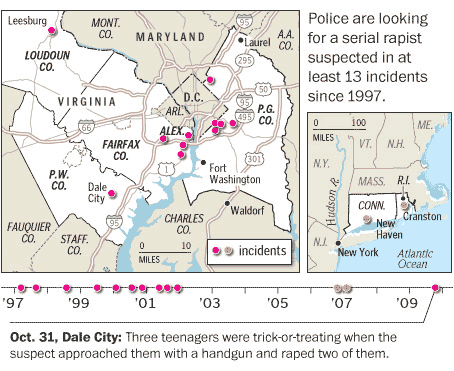
Meanwhile, police in the Washington D.C. area are using the media to appeal to the public to help them find the “East Coast Rapist.” There should be more publicity. This rapist has been active for at least 12 years: DNA tests reveal a pattern of travel between the D.C. suburbs, Connecticut, and Rhode Island during that time.
So there is a chance that somebody else knows the identity of the rapist because of his changing locations. Profilers used to assume that serial rapists and serial killers were loners, but this, like so many other presumptions (ie. serial killers are usually white men, serial offenders pick only one type of victim) have been proven to be false.
The Washington Post has an interactive map listing the locations and dates of the East Coast rapist’s attacks in today’s paper:
The rapist may have been in prison for some other crime between 2002 and 2007, and even 2007 and 2009. You have to figure that officials in Washington D.C., Connecticut, and Rhode Island have already submitted DNA to the national database, so if he had ever been convicted of a sex crime, or even served time for some other felony in most states, his DNA would be on record somewhere.But who knows? Maybe he was committing sex crimes in one of the many places where DNA samples don’t get processed properly, like Wisconsin and Michigan and California. Maybe he’s supposed to be behind bars but hasn’t been picked up yet because nobody is bothering to keep track of thousands of offenders who have absconded on bail, the situation in Philadelphia.
It’s all about resources. Twenty-two years after the first use of DNA in convicting a serial rapist, there should be no backlogs. Rape is too important. Thousands of offenders shouldn’t still be walking out of prison after skipping their DNA tests, through deceit or carelessness. Every one of these cases represents a denial of justice to someone.
Too bad criminal justice activists and law professors and university president-types don’t get all worked up when the person being denied justice is the victim, instead of the offender.
When I purchased the transcripts from some of Henry Malone’s many perambulations through the courts (and how nice that I had to pay, and pay a lot, for them), I was astonished to read the details of one hearing that was held at Malone’s behest because he demanded reimbursement for a fine related to his car, which had been impounded when he was arrested for sexual assault. The judge and the defense attorney seemed amused by his bizarre demand. I don’t find it so funny. Imagine what we paid for the judge to read that demand, for the lawyer to research the claim and represent Malone in court, for the court reporter, and the security guards, and everything else that went into assuring that Henry Malone would get to be heard in court over an inane and dismissible whim.
The same courthouse where I had been denied the chance to face Malone for raping me because nobody wanted to bother spending the money to try him for more than one rape. Criminals have rights the rest of us can’t dream of. It’s all about the resources, and every last dime goes to offenders; they get everything they want, whenever they want it, out of the courts, while their victims wait out in the cold.