-
Jordan Gibson, Jose Reyes, Wilson Gomez, Leonard Scroggins: “I didn’t want to be one of those cases where you find my remains three years from now.”
Posted on June 3rd, 2010 No commentsYou wouldn’t know it from the way many in the media cover crime, but recidivists with extremely violent records are still routinely cut loose from prison early, or allowed to stay free while awaiting trial.
Or allowed to attend high school with nobody knowing they’re sex offenders.
But wait, isn’t America supposed to be a police state, where people sometimes shockingly serve full sentences for their crimes? Not in these cases:
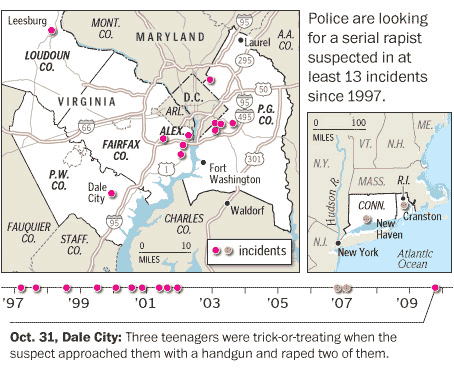
Jordan Anthony Gibson, Atlanta, Georgia:
Gibson is currently a suspect in multiple rapes. But even though he was caught in 2009 with items belonging to the rape victims, it took police a year to get back DNA results from the State Crime Lab positively tying him to two of the sex crimes. This story says a lot about the state’s priorities, letting a suspected serial rapist’s DNA collect dust on a shelf for 13 months while some judge actually let the suspect walk free. It also says a lot about the way the defense bar has convinced the judiciary to raise the bar way too high on evidence in criminal convictions: why isn’t being in possession of rape victims’ property enough to try someone for rape? Why couldn’t he have been tried, or at least actually held under real supervision, on burglary or robbery charges until the DNA came back? Don’t we have enough laws on the books to keep people like this off the streets for their other crimes. of course, that would involve the courts actually displaying a commitment to treating crime like crime.
Part of the problem is the perception that crimes like burglary and robbery are now deemed too minor to even address. And we know who to thank for that. yet, somehow, the Atlanta Journal Constitution wants you to believe that we are far too harsh on criminals. And so, you have a man now known to be a serial rapist, who could have been prosecuted for robbery and kept behind bars as the rape investigation continued, instead set free for a year as the crime lab didn’t bother to prioritize its work in a timely way. Money problems? Well, then, they should be using a case like this one to yell from the rooftops that they need more funds. They don’t make waves like that, though.
Nor do Atlanta’s politically motivated “victim advocates” — many of them campus rape activists — who would rather berate all men for alleged sexist insensitivities than get their fingers dirty actually advocating for swift justice against a real rapist. Oh, for the days when there were real feminists. Here’s the serial rape story:
Police charged a man Friday for two of a string of rapes early last year along the Briarcliff Road corridor. DeKalb County Police investigators believe Jordon Anthony Gibson may be responsible for more sexual assaults, however. Gibson, arrested Thursday, had been in police custody [that's an ankle monitor, not jail] for more than a year on related charges. On April 11, 2009, Gibson, 19, was stopped for a traffic violation, and police found property from the rape victims inside his car, DeKalb County police spokesman Jason Gagnon said. Police, at the time, charged him with several counts of robbery, but continued to consider him as a person of interest in the series of rapes, Gagnon said. DNA samples were taken from Gibson at the time of his arrest, but they were returned only a few weeks ago, police said. The GBI’s results showed Gibson to be a positive match in two of the rapes.
Umm, so why wasn’t he arrested weeks ago? Why wasn’t he picked up the very same day that the DNA results were known? What exactly does it take to remove a dangerous, DNA-identified rapist from the streets, especially when he’s facing a long prison sentence? Why did the warrant take “weeks” after the DNA match?
“We had a strong feeling that he was our guy, just due to the fact that those sexual assaults discontinued the minute he was arrested,” Gagnon told the AJC. “However, we didn’t have the evidence. After the robbery charges, Gibson was released on a $60,000 bond and given an ankle monitor. “We wanted to keep up with him,” Gagnon said. There were at least five more rape victims for whom Gibson’s DNA did not match. “Sometimes DNA can possibly be tainted,” Gagnon said, in explaining why there were not more matches. As far as waiting a year for DNA results, Gagnon said investigators were patient. “We’re just glad it came,” he said.
Look, at some point, somebody in the system needs to stand up and say:
Waiting a year for DNA results in serial rapes with the main suspect out in the community is NOT acceptable. Having a court system in which we can’t even push a robbery conviction to get a suspected rapist behind bars while we investigate his other crimes is NOT acceptable. If the courts are so distracted and overwhelmed that they can’t process a case like this in less than 13 months; if the DA doesn’t feel it is a priority to get a guy like this off the streets ASAP, then we really don’t have justice. We really don’t have courts; we really don’t have prosecutors who can say they’re representing the people. We don’t have anybody bothering to prevent the next preventable rape.
I understand why a cop can’t say this. What I don’t understand is why a judge won’t say it. Somebody needs to be the person who has the courage to challenge this type of utter failure.
Somebody . . . some politician, some DA, some well-paid victim activist, needs to speak up.
~~~
Because when nobody speaks up, this is what happens: Jose Reyes, Seattle, Washington
A convicted sex offender is accused of raping a special education student at Seattle’s Roosevelt High School. KING 5 [news] has learned some staff [k]new a sex offender was at the school, but parents and students did not. Prosecutors say 18-year-old Jose Reyes convinced a 14-year-old freshman to go into a girls bathroom at Roosevelt to make out. But, he then forced himself on the student. Other students believe he was in some sort of relationship with the girl. Few at Roosevelt knew about Reyes’ disturbing past: In January of 2007, police say Reyes lured a 10-year-old-girl into a public library parking garage and asked her to take off her pants. In April of 2007, he was charged with trying to lure an 11-year-old girl at a [G]reenwood park. And in May 2007, he tried the same thing with a five-year-old girl, asking her to sit on his lap in exchange for trading cards.
And those are the crimes he was caught committing. Of course, if this were the New York Times reporting the story, they would probably describe Reyes as the victim of a vile Romeo and Juliet law and leave out the part about the five-year old.
When Reyes started school this year, certain teachers, staff and security were told that he is a Level 2 sex offender. State law dictates that no one else is required to be notified. Many parents say that’s ridiculous. . . The Seattle School District says while Roosevelt was notified of Reyes’ sex offender status, the report did not give details about his past and that report never made it from police to the school district itself.
I wonder why Reyes was granted a Level 2 status, given that he was a recidivist who targeted extremely young victims. Should his age matter, when he predated small children? Were some of the charges dropped (like they are always dropped), and that is why he was free to rape a special ed. student?
Shouldn’t every sex crime be prosecuted?
~~~
And shouldn’t sex crime cases take less than, say, a decade to process? Especially when the rapist spends that time walking free on the streets and then commits another sex assault? Was this a DNA-delayed case? Something else? Wilson Gomez, Brandon Florida:
A Brandon man already facing rape charges from last year was arrested Saturday morning on similar charges, according to an arrest report. Deputies arrested Wilson Gomez, 50, at his home at 202 Mason St., after, they say, he had sex with a woman who did not give her consent. He is charged with sexual battery, the report said. Gomez was arrested in 2009 and charged with sexual battery using a deadly weapon or force causing injury in connection with a 2001 incident, jail records show. According to Hillsborough County court records, these charges are part of an ongoing case and he has not been convicted. Gomez is held without bail at the Orient Road Jail.
It seems that when offenders know they’re going to jail, they often act out. Why don’t judges see this? Why do they keep letting dangerous predators go free to await trial? Like, in the next case.
~~~
Leonard Earl Scroggins, San Diego, California:
Scroggins is a convicted recidivist sex offender (very) recently out on parole who was allowed to remain loose even after fondling a child a few days after getting out of prison. Astonishingly, San Diego Deputy District Attorney Enrique Camarena feels that letting the two-time convict remain free after the sex offense against a child was a sign that the system is working, because Scroggins is now facing life in prison for removing his monitoring anklet and sexually assaulting four other females in a crime spree last week, including a 13-year old girl he stabbed and tried to kidnap at knife-point and another woman attacked with a knife.
That means the system is working? Using women and children as prey because we’ve raised the bar so much on prosecuting anyone for anything that you practically have to kill a child to get put away? That’s a solution? What does the system look like when it’s not working?
The prosecutor in the case says he is not frustrated with the system even though Scroggins has a history of breaking the law and violating parole. “Unfortunately we have to get to this point where the guy commits serious acts on consecutive days, to multiple victims to get to this point where he is going to spend the rest of his life in prison. But that’s a big punishment and I think as a society we have to wait until the time is right,” says Camarena.
“Society” has to “wait until” what??? Look, even though he was in Napa Valley, this guy wasn’t selling no wine before its time: he was kidnapping women and children at knife-point after the proud state of California cut him loose early for two previous sex crimes and failed to hold him accountable for attacking a child. I don’t know if D.A. Camarena is some wanna-be pol using his current office to climb the political ladder, or some wanna-be defense attorney using taxpayers and victims to train for his future job by working for the prosecutor’s office (a not uncommon scenario), or if he is actually a decent law-and-order guy driven insane by the impossibility of bringing charges against anyone for anything these days. But it is appalling to say that any woman or child should be sacrificed to “serious acts on consecutive days, to multiple victims” to get a bloody prosecution rolling.
Jesus wept.
I don’t quite know how to express this because it should not need to be expressed, but the system wasn’t working when Scroggins walked out of prison early for two rapes. It wasn’t working when he attacked a child and got away with it in March. It wasn’t working when he wasn’t punished for violating his parole — by molesting a child — and remained free on an ankle monitor. It’s not working if you need a high-tide body count before the D.A. feels he can proceed with prosecuting a dangerous recidivist predatory child sex offender. And if the D.A. reacts to these circumstances by making excuses instead of shouting from the rooftops, something is very, very broken.
Here are Scroggins’ prior offenses. Or, at least, the ones that someone bothered to prosecute:
Department of Corrections documents show convicted sex offender Leonard Scroggins in and out of prison. Back in the mid-90’s he was sentenced to ten years for rape in Napa County. He served four and a half, but violated his parole twice; finally being released in 2003. A couple of months later, Scroggins went back to prison after pleading guilty to a terrorist threat involving kidnapping and rape. He again violated parole, and was just released from prison this past March.
That’s two violent sex crimes, three parole violations. Then came the un-prosecuted child molestation (please drop the “fondling” bit), which apparently led to the ankle monitor but no prison time. Then the rampage this week, which relieved the District Attorney of actually having to take a stand by trying Scroggins on one child charge before he committed more sex crimes.
Look, I’m sympathetic to the difficulty of getting charges to stick in this joke of a justice system. But can’t the D.A. so much as express mild disgust that his hands are so tied? Isn’t that his job?
Meanwhile, as politicians fuss over expensive-yet-futile measures like requiring sex offenders to provide their e-mail addresses and instant messaging names to police, or creating yet another freeway alert system to warn of offenders who are “misbehaving” (their term) or absconded, the one sane voice in the California crime cacophony is that of Scroggin’s 13-year old victim. She harbors no illusions about the stakes of the game:
Scroggins [put] a knife to the throat of a 13-year-old girl and tr[ied] to drag her into his car. “He kept repeating in a low voice, ‘Get in the car or I will cut you,”‘ said Guadalupe Perez, an eighth-grader at National City Middle School. The girl said she screamed and reached for the knife, cutting her finger, then elbowed the man and ran. “If I didn’t do that, I wouldn’t be here today,” she said. “I didn’t want to be one of those cases where you find my remains three years from now.”
“I didn’t want to be one of those cases where you find my remains three years from now.” Shame on the rest of us.
-
Jeffrey Dwight Carr, Michael Ray Tackett: Violent Recidivists Wandering the Streets
Posted on June 2nd, 2010 No commentsWhile investigative reporters and their academic mouthpieces busily crochet their latest screeds against the notion of putting criminals in prison, here’s a quick sampling of people who should have been behind bars, but weren’t. Of course, this isn’t a criminological study, because we’re going to actually mention the crimes these men committed, instead of just breathlessly envisioning the endless possibilities of their next “re-entry” into society.
It looks like the last re-entries were easy to a fault.
Jeffery Dwight Carr, Orlando Florida:
Police in Central Florida say a registered sex offender cut off his electronic ankle monitor, kidnapped a woman and tried to have her cash a $1,000 check. Jeffery Dwight Carr has been charged with robbery, false imprisonment and kidnapping.
Although his juvenile record is not available, Carr wasted no time racking up offenses the minute he turned 18: five auto theft convictions in two years. How precocious of him. He got a rolling slap on the wrist and just a few months behind bars, which is too bad, because if he hadn’t, he wouldn’t have been free to commit that sexual assault of a minor in 2002.
Of course, people don’t serve time for every crime they commit, so once they’re popped for something, it makes a certain kind of criminal sense to keep committing more crimes, because you won’t actually serve more time for them. Unless the state has a recidivism law. And bothers to enforce it. Which Florida does. And didn’t. Oh well. He’s behind bars now, and the victim was very lucky to escape with her life.
~~~
Michael Ray Tackett, Pittsburgh, Pennsylvania:
You’d think we’ve lost enough police officers recently. None were injured hauling Tackett back into custody last week for the brutal, armed 2007 rape of a real estate agent, thank God. But why was he out on bond awaiting a 2009 charge for the brutal, armed rape of another real estate agent, when he has a criminal record of multiple rape charges, and a neighbor reported that this was Tackett’s second armed standoff with the police?
Tackett was previously acquitted twice for raping women who were prostitutes, in 2003 and 2005. Both women admitted to selling sex to him on different occasions but went to police when he became violent, pulled weapons, and raped them. You would think that type of history would be enough to keep him in jail awaiting trial after he committed his 2009 rape — of a real estate agent he stalked and attacked in an empty house she was showing. Yet after that terrifyingly violent crime, and despite his extremely scary record, Tackett told the court that he had a back problem that couldn’t be addressed in prison, so he’d need to await trial at home. The judge actually bought the back pain story and decided Tackett was a good candidate for pre-trial bond. You know, like Ted Bundy:
Dec. 16, 2009: A West Pittsburg man accused of luring a real estate agent to an empty Jefferson Township house and raping her June 11 is free on bond. Michael R. Tackett, 38, had his bond reduced Thursday from $200,000 to $100,000 by Mercer County Common Pleas Court Judge John C. Reed after his defense attorney Thomas W. Leslie called the initial amount excessive. Assistant Mercer County District Attorney Ryan Bonner said Tackett testified Thursday that he required medical attention due to back surgery, and that he couldn’t get it through the Mercer County Jail. . . “Obviously, we were disappointed and alarmed that he bonded out,” said state police trooper Dan Sindlinger. He said Tackett is potentially dangerous and may have a pattern of targeting real estate agents, and warned them not to show homes alone.
In other words, the judge decided that rather than using stuff like prison guards and bars to keep an eye on Tackett, he would place the burden for watching out for him directly on the real estate agents he was known to be stalking. After all, lots of real estate agents are part-time ninjas trained in taking down potential serial killers, right?
Tackett was charged with rape in 2003 and 2005 in Lawrence County and acquitted both times, according to published reports. . . Authorities said Tackett met the woman during a real estate open house. About a week and half later she was showing him a house on Seidle Road when police say he pinned her down, told her he had a gun and raped her repeatedly. Tackett threatened to kill the woman. He ordered her to answer questions about her family, recited her address, and threatened to kill her and her family if she reported the incident, police said.
And now, the parade of technicalities begins:
Tackett used a fake name when he contacted the woman but she found a photo on the state’s Megan’s Law sex offender registry that looked similar to the man she said raped her, police said. A Neshannock Township policeman saw the picture, which was not Tackett’s. He realized it looked like Tackett, with whom he’d dealt before. The policeman showed the woman Tackett’s picture, and she confirmed it was him. Leslie is trying to have that identification, and any subsequent courtroom identifications of Tackett suppressed in the case. He said showing the picture outside a lineup was “unduly suggestive.” A hearing is scheduled for Jan. 6 on that motion. In a later state police lineup, the woman said she was “100 percent sure” it was Tackett who raped her, police said. She also identified Tackett’s car, and was able to point it out from a block away while driving through West Pittsburg with her husband, police said.
The details from the 2007 rape are also chilling:
[Tackett] had been sought by police in the rape of a real estate agent on May 24, 2007. State police said the agent had agreed to meet with Tackett to show him a home along Huson Road in Woodcock Township, Crawford County. According to documents filed earlier this year in the office of District Judge Lincoln Zilhaver of Saegertown, Crawford County, the agent showed the house to Tackett, who had given her the false name of Randy Thompson, for about four hours, starting around 10:30 a.m. Toward the end of the showing, Tackett asked to see the basement. Once in the basement, police said Tackett used a stun gun on the woman and raped her. The woman provided a detailed description of her attacker, including his height and weight, that he wore glasses, had a tattoo and shaved his pubic area. She also identified Tackett in a photo lineup. During the investigation, police searched Tackett’s wife’s car, which the woman also described to police as the vehicle used by her attacker. That vehicle search turned up items including a copy of Real Estate magazine and a stun gun.
This sounds like a case where insane pro-offender evidence rules, in addition to judicial and juror leniency, slowed down police in their efforts to contain a suspected serial rapist and, possibly, serial killer. Let’s hope the body count isn’t too high. But of course, the real problem is that we just put too many people in jail, man.
Tomorrow: more violent recidivists wandering the streets . . .
-
Rodney Alcala’s Criminal Appeals: Is Alcala Smart, Or Is The System Stupid?
Posted on April 2nd, 2010 1 commentMuch is being made about Rodney Alcala’s allegedly superior intelligence. I don’t buy it any more than I buy it when defense attorneys wave a piece of paper in the courtroom and claim their client is mentally challenged and thus deserves a break. It’s just theater. Alcala’s a haircut with cheekbones: his IQ, whatever it might be, matters far less than the pro-offender sentiments of the era when he was first tried, and re-tried.
It certainly didn’t take a rocket scientist to play the California criminal justice system for a fool back in the 1970’s. Unfortunately, in many ways, the same is still true.
Here are ten specific breaks the system gave Alcala, breaks that either enabled him to add to his body count or torment the families of his victims. Such breaks weren’t reserved for serial killers with MENSA memberships, which is why places like L.A. were so fatal for all sorts of women.
How fatal? Seven, or fifty, or even 100 women and girls, depending on how much evidence Alcala provides and the police uncover with the massive public appeal for assistance now underway. Again, I have to ask: why weren’t these pictures distributed to the public decades ago? Why were families forced to sit in limbo while authorities had hundreds of photos linking a known sadistic rapist and murderer to scores of unidentified women and girls? I’m sure the police, given adequate resources, would have worked these cases. But we’ve never given police adequate resources. We still don’t charge even serious offenders with the totality of their known crimes.
Still it’s a tribute to reformers that some (though not all) of these fatal justice system errors would not occur today.
#1: Judicial Leniency, Indeterminate Sentencing Sets a Killer Free, 1971
Rodney Alcala was 25 in 1968, when he was caught in the act of raping and beating an eight-year old child to death. That’s a chilling number, 25. Kidnapping from a public place, the brutality of the rape, the extreme violence — all are hallmarks of an experienced, brazen killer who had escalated his behavior long before that crime. If Alcala conformed to typical patterns (and there’s no reason to believe he did not), he probably started sexually victimizing girls and women around the time he reached puberty, a full decade before he attacked “Tali S.” That’s potentially a lot of unnoticed crimes:
His first known attack was in 1968, when he abducted a second-grade girl walking to school in Hollywood, using a pipe to badly bash her head and then raping her — only to be caught red-handed because a Good Samaritan spotted him luring the child and called police. When LAPD officers demanded he open the door of his Hollywood apartment on De Longpre Avenue, Alcala fled out the back. Inside, police found the barely-alive, raped little girl on Alcala’s floor. It took LAPD three years to catch the fugitive Alcala, living under the name John Berger in New Hampshire — where the glib and charming child rapist had been hired, disturbingly, as a counselor at an arts-and-drama camp for teenagers.
Attempted murder, plus kidnapping, plus rape of a child, plus absconding. Seems like he’d never see the light of day again. Unfortunately, for future victims at least, pro-offender psychologists and other activists had so infiltrated the criminal justice system in California that the horror of Alcala’s crime was ignored by the courts. From the moment he appeared in some California judge’s courtroom, he ceased to be a (failed) killer and child rapist. He became a client and recipient of social services, a victim needing guidance, rehabilitation, “education,” and counseling. It’s a soul-sickening travesty, one that deserves more exposure:
When Alcala was caught hiding out under the assumed name Berger on the East Coast [in 1971], a conviction for brutally raping a child in California was not a guarantee of a long prison sentence. California’s state government of that era had embraced a philosophy that the state could successfully treat rapists and murderers through education and psychotherapy. The hallmark of the philosophy was “indeterminate sentencing,” under which judges left open the number of prison years to be served by a violent felon, and parole boards later determined when the offender had been reformed. Rapists and murderers — including Alcala — went free after very short stints. He served a scant 34 months for viciously raping the 8-year-old, who is known in official documents only as “Tali” . . . Deeply controversial, “indeterminate sentencing” was ended by then-governor Jerry Brown. But by that time, Alcala was free. . . . Retired LAPD Detective Steve Hodel, who investigated Alcala’s rape of Tali, recalls, “My impression was that it was his first sex crime, and we got him early — and society is relatively safe now. I had no idea in two years [he would be out] and continue his reign of terror and horror. I expected he was put away and society was safe. … It is such a tragedy that so much more came after that.”
“Education and psychotherapy.” For raping and trying to kill a little girl. It is important to understand that these highly educated “experts” were not simply trying to grope towards to some psychological discoveries that would only be discovered later.
Knowledge that murder is bad, for example, pre-dates 1971.
As I’ve written previously, I believe Alcala would have received a more severe sentence if he had just bludgeoned the little girl, instead of raping her and bludgeoning her. I suspect the rape actually acted as a mitigating factor, turning him into a victim in the eyes of the people empowered to run our courts. For when a prison psychiatrist found him “considerably improved” and ready for release less than three years after being convicted of attempted murder and child rape, that psychiatrist was undoubtedly referring to the fad psycho-sexual therapies in use at the time — and still being promoted by many academicians and practitioners today. Like Dr. Richard Rappaport, Associate Clinical Professor of Psychiatry, UCSD Medical School, San Diego, who testified in Alcala’s most recent trial that Alcala should not be held responsible for serial sex murder because he just can’t help enjoying . . . sexual murder.
#2: Parole Board Leniency, 1974
It takes two to tango: a judge who refuses to hold a sick predator responsible for his crime by giving him an indeterminate sentence, and then a parole board that decides the “rehabilitation’s taken.” Who served on that parole board in 1974, the one that decided to cut Alcala loose? I’d love to see the transcript. If anyone would send it to me, I’ll post it. This wasn’t some gray-area first offense. I wonder why the media hasn’t sought out these people and asked them why they let Alcala go. As public servants, the parole board members should feel obliged to revisit such a devastating error. A year’s worth of such decisions would make interesting reading — and yet one more interesting corrective to mythic beliefs that our country is too harsh on criminals.
#3: Prosecutorial/Judicial Leniency, Not Believing a Victim, Failure to Punish Recidivism, 1974
After the parole board cut him loose, it took Alcala two months to get caught with another child. Two months. Or, possibly, less:
In 1974, two months after he got out of state prison, Alcala was found at Bolsa Chica State Beach with a 13-year-old girl who claimed he’d kidnapped her. He was convicted only of violating parole and giving pot to a minor, however . . .
A convicted, violent, child rapist is found with a 13-year old girl who tells police she has been kidnapped. What happens next? Somebody doesn’t believe the child. Who? The judge? The prosecutor?
#4: Parole Leniency, 1977
Alcala served another short sentence, and was apparently declared “re-reformed.” Then a parole officer cut him some breaks. It makes you wonder: was there anyone, anywhere in California’s criminal justice system, outside police themselves, who harbored a negative attitude towards violent offenders?
[T]wo years later, upon his second release from prison, the law went easy on Alcala again. His parole officer in Los Angeles permitted Alcala, though a registered child rapist and known flight risk, to jaunt off to New York City to visit relatives. NYPD cold-case investigators now believe that one week after arriving in Manhattan, Alcala killed the Ciro’s nightclub heiress Ellen Hover, burying her on the vast Rockefeller Estate in ritzy Westchester County.Orange County Senior Deputy District Attorney Matt Murphy, who hopes during the current trial to put Alcala permanently on death row for Samsoe’s 1979 murder and the slayings of four women in the Los Angeles area, says: “The ’70s in California was insane as far as treatment of sexual predators. Rodney Alcala is a poster boy for this. It is a total comedy of outrageous stupidity.”
#5: Social Leniency, 1977 – 1979: The Polanski Effect
It really does take a village. Between the time Rodney Alcala was released from prison on his second child offense charge, and when he was captured after the murder of 12-year old Robin Samsoe, it seems that nobody he encountered (outside the police) felt it was right to judge him for — oh, little transgressions like trying to murder a young child he was raping, or being a suspect in several other murders, or being investigated in the Hillside strangler cases, or ending up on the FBI’s Ten Most Wanted list. Surely, FBI agents and other detectives approached Alcala’s co-workers and employers when he was being investigated for these crimes; surely his family and friends and professional acquaintances knew about the rape and beating of the 8-year old child.
So why did the L.A. Times choose to hire him anyway? Why didn’t his supervisors there act on the knowledge that he was circulating his home-made child porn to co-workers? Why did the Dating Game producers allow a child-rapist on their show? Why did Alcala have such success in high-end social circles, in the art world, and with celebrities such as Roman Polanski? Well, that one’s pretty easy to answer.
Was Alcala’s social success, in fact, based on his status as a “sexual outlaw,” being “persecuted by the pigs”? Such was the argot in newsrooms and art circles, after all. Funny how all the people who knew him then are so tight-lipped now: it sounds as if he really got around, between slaughtering young women:
1977 Ellen Hover, Jill Barcomb (18), Georgia Wixted (27)
1978 Charlotte Lamb (32), Monique H. (15), Jill Parenteau (21). And more to come.
#6: Yet More Judicial Leniency, and Help From Mom, 1979
Another kidnapping and rape, another lost chance to get Alcala behind bars. The police catch ‘em and the courts let ‘em go, leaving two more girls dead. This type of behavior from the bench, sadly, continues today:
Alcala’s alleged reign of terror might have been halted in early 1979, when a 15-year-old hitchhiker called police from a motel in Riverside County to report she had just escaped from a kidnapper and rapist. Although Riverside police quickly charged Alcala with kidnapping and rape, a judge set his bail at just $10,000, paid by his mother. While free, police say, Alcala killed 21-year-old computer keypunch operator [Jill] Parenteau five months later in her Burbank apartment. The killer cut himself climbing through her window, and prosecutors now say Alcala’s rare blood type has been matched to the blood remnants. Six days after Parenteau’s slaying, Robin Samsoe disappeared, a child-snatching that sent fear rippling through safe, quiet Southern California communities. Samsoe’s friend Bridget told police the two swimsuit-clad girls were approached that day by a photographer who asked if he could take their pictures. The man was scared off by a suspicious neighbor, but shortly after that, Bridget lent Samsoe her yellow bicycle so that Samsoe could make it to ballet class. Samsoe was never seen again. Detectives circulated a sketch of the mysterious photographer to the media, and a parole officer recognized his parolee Alcala. Twelve days after she vanished, on July 2, 1979, Samsoe’s skeletal remains were found by U.S. Forestry Service rangers. Alcala was arrested on July 24 at his mother’s house in Monterey Park.
#7: Criminal Appeals, 1984
Alcala was found guilty of murdering Robin Samsoe in 1980 and was sentenced to death. But that verdict was overturned in 1984 by the California Supreme Court. The court found that the jury had been “unduly prejudiced” when prosecutors introduced information about about the rape and attempted murder of the 8-year old child in 1968.
Evidence of prior crimes is sometimes admissible at certain times, so long as the priors are materially similar to to crime being tried. For instance, is raping and trying to murder an 8-year old girl at all similar to raping and murdering a 12-year old girl? There’s a four-year difference in the ages of the victims there, and a higher success component on the whole “murder” thing. I’m sure, however, that the California Supreme Court could not have overturned Alcala’s death sentence on such a frivolous distinction. It must have been some other frivolous distinction.
#8: Criminal Appeals, 2001
This time, the 9th U.S. Circuit Court of Appeals got a piece of the action. They decided that, because one witness’ testimony from a previous trial was read from the stand without the witness being in the room, the entire second trial, which doubtlessly cost hundreds of thousands, if not millions, of taxpayer dollars to re-try, simply had to be tossed out because of this.
What’s the matter with the 9th Circuit Court of Appeals? Richard Posner says they’re just too large for their own good, with too many different justices thinking together, and he’s got a well-known large brain that thinks in perfect unison with itself. Me, with my quotidian little intellect, I think they just never saw a serial killer appeal they couldn’t bleed for, since they don’t have to, like, literally bleed, like the victims. Not a very elegant argument, I know, but maybe it would pass muster before the 9th U.S. Circuit Court of Appeals.
#9: Alcala’s Exclusive Access to the Courts, 1979 – 2010
With his denim pantsuit aesthetic and not-very-bright courtroom performances, Alcala doesn’t really present as a brain trust. But he doesn’t need to be one. And defendant can tie up the courts — and further devastate victim’s families — with frivolous lawsuits and endless appeals designed to catch certain activist judges’ eyes:
Alcala has spent his time behind bars penning You, the Jury, a 1994 book in which he claims his innocence and points to a different suspect; suing the California prisons for a slip-and-fall claim and for failing to provide him a low-fat diet; and, according to prosecutors, complaining about a law that required he and other death-row inmates to submit DNA mouth swabs for comparison by police against unsolved crimes. Alcala is still as cocky as ever — bold enough to represent himself in the trial for his life, now unfolding in Orange County. And why not? He has a talent for mining legal technicalities and has repeatedly enjoyed success with appellate judges.
Orange County prosecutor Matt Murphy likens Alcala to a video game villain that keeps coming to life and says that the appellate courts have hit restart on this real-life murderous villain’s rampage through the system. The families of the victims as well as those close to the investigation criticize the decisions as misguided political statements by justices who opposed the death penalty and ignored the facts of the case. For Murphy, who tried the latest Samsoe case, each decision to overturn stripped away more evidence from his arsenal against Alcala. And for Robin Samsoe’s family, the legal setbacks have altered the course of their lives, ripping through like aftershock upon aftershock following a devastating earthquake. . . Samsoe’s mother [Maryanne Connelly] spoke eloquently about the hardships she has endured in the 31 years since her daughter’s murder, waiting for justice that never came. . . Meanwhile, her daughter’s killer has spent most of his life in prison, and has perfected the art of working the system to his advantage, filing lawsuit upon lawsuit when he felt his rights were violated while in custody – such as a civil suit against an investigator who did not respond to a request for discovery within 10 days. In fact, a contempt case against the Orange County Jail is still pending. . . Connelly wonders where her rights were, while the man who killed her daughter became comfortably institutionalized. This inequity has become the rallying cry of all the victims’ families, as well as victim’s rights advocates, who say the system has coddled a vicious killer while failing victims’ loved ones.
If the victims’ families had the same rights as Alcala, they could sue him for mental cruelty. Where such a trial could be held is a difficult question, because his co-defendant would be the justice system itself.
#10: Turning the Courtroom into His Last Killing Field, 2010, and Beyond
“He was blowing kisses at me across the courtroom, and I thought I was going to lose my mind,” Connely said. “And I thought I was going to go crazy, you know. And I reached into my purse and I was going to grab it, you know, and I thought, ‘I can’t do this.’”
That’s Marianne Connelly, speaking recently about Alcala’s 1980 trial for the murder of her daughter: back then, she once brought a gun to the courtroom to shoot Alcala. I doubt anyone would have blamed her then, and they certainly wouldn’t blame her now, after thirty more years of sitting in courtrooms watching Alcala toy with her, and other victims, for fun.
Where was the judge while Alcala was blowing kisses at his victim’s mother? Did that judge feel his hands were tied, thanks to our perverse appeals system? Or did he simply not care? Why did he allow the defendant to behave that way?
This unique, public humiliation and torture of crime victims is one thing that has not changed in 30 years. From the most recent trial:
Robin’s brother Tim Samsoe, 44, said the worst thing was watching Alcala perk up in court every time he got the chance to see old photographs of his alleged victims. “You see the gleam in his eye,” said Samsoe. “He’s enjoying this again.”
According to prosecutors, Alcala always enjoyed torturing his victims:
[Orange County Senior Deputy District Attorney Matt] Murphy told the packed courtroom that Alcala took his time terrorizing his victims by choking them with his bare hands, waiting for them to wake up at least once, then strangling them again — sometimes using shoelaces or panty hose. “It is a staggeringly horrific way to die,” exclaimed Murphy. “There is ample evidence the women put up some resistance….He gets off on it. It was fun.” Once they were dead, Alcala allegedly [he has since been found guilty] would then pose their bodies.
Now the only victims he has access to are the relatives of the women and children he killed:
Robert Samsoe, who was 13 when his little sister was slain, tells L.A. Weekly, “I don’t have any faith in the system. Some people, they are just afforded all the chances in the world. Alcala has cost the state of California more than any other person because of his lawsuits. And they treat him like a king. Everybody is walking on pins and needles around him.
Alcala dragged out his latest trial for weeks, representing himself, attacking victims, rambling on and enjoying himself. If this judge felt he simply had no power to prevent such behavior, he should now take steps to do something about the warped system of which he is a part. When is enough enough?
At the trial’s close, Alcala forced family members to listen to a recording of Alice’s Restaurant, a move that nearly drove one columnist to violence. Frank Mickadeit, of the OC Register, wondered how family members could hold themselves back:
To make the family and jurors listen to somebody, even Guthrie, sing: “I wanna kill. Kill. I wanna, I wanna see, I wanna see blood and guts and veins in my teeth”? I guarantee you, that made nobody in the room think about how horrible Alcala’s death might be, as was apparently his intent. . . In all the years I’ve covered trials, I’ve never once wanted to personally wreak vengeance on a defendant. I can dissociate along with the hardest of professionals. But at Minute 50 on Tuesday, Murphy got me to go to that unprofessional place, where the father, brother and uncle lives. I think it might have been one young woman’s morgue-photo – a head that was missing a third of its face because Alcala had bashed it away with a rock. I stared hard at the back of Alcala’s tan sports coat, where the collar met the unruly mass of gray curls that cascades down his back (Arlo-like, if you must know), and I thought hard about that 15 feet between me and that thin neck. A cat-like leap, a bound, a forearm-lock, a snap – he’d never see me coming. The burly deputy sheriff between us would, though, so there was no chance even if I had indulged my momentary fantasy. I looked to my left. Immediately across the aisle from me was Robert Samsoe, Robin’s brother – roughly my age and size. He was wearing jeans, penny loafers and white socks, and I could see his right foot tapping nervously during these last 10 minutes of Murphy’s closing. The photo of another victim, her lower lip torn away, flashed up. Murphy hadn’t even begun recounting Robin’s death yet. . . Mercifully, there are no morgue photos of Robin, at least not in the sense that there are of the other murder victims. When they found Robin, just a skull was left – albeit a disfigured one from where Alcala had bashed in her teeth. Robert Samsoe didn’t leap out of his chair and break Rodney Alcala’s neck, as part of me would have like to have seen.
Of course he didn’t. The victims figured out long ago that they are not actually people, with human rights, including the right to dignity, in the eyes of the law. The only person in that courtroom whose rights were being protected was Rodney Alcala.
It doesn’t have to be that way.
-
Rodney Alcala: The Forrest Gump of Sex Murder. And What That Says About the Rest of Us.
Posted on March 31st, 2010 7 commentsYesterday, serial killer Rodney Alcala was sentenced to death for the third time for the 1979 murder of 12-year old Robin Samsoe. He was also sentenced for the torture-killings of four other women.
Today, the media is reporting brief, painful snippets about the five victims. Many other victims are believed to exist.
Tomorrow, Alcala will undoubtedly begin appealing the sentence again. Why not? The taxpayers of California pay his legal bills: his lawyers have grown fat over the past three decades, helping a serial killer play games with the appeals process. The victims have spent lifetimes sitting in courtrooms watching him toy with their loved ones’ memories.
Perhaps the worst part of this story is the role played by certain culturally powerful people who knew about some of Alcala’s most vicious crimes but still allowed him get out of prison or provided him with the cover of social credibility.
Had Alcala been put away for life after he was caught, in 1968, in the act of raping and beating an 8-year old girl, his later victims — Georgia Wixted, Jill Parenteau, Charlotte Lamb, Jill Barcomb, Robin Samsoe, and others — would be alive today. But in 1971, at his sentencing, the state of California decided that Alcala deserved another chance. They gave him to just a handful of months for the crime, practically letting him walk free for the near-murder of an 8-year old. The child survived only because police broke into Alcala’s house while he was beating her head in with a steel pipe.
This sentence is a perfect illustration of the theory that, until recently, predators actually received lesser sentences when they sexually violated their victims. I believe Alcala would have gotten a much longer sentence if he had merely tried to kill the child, without raping her, too. In the therapeutic environment of the 1970’s justice system, being a sexual offender was literally an excuse for lawbreaking. Sex offenders were to be pitied, if not slyly admired.
Anybody care to challenge that?
Now for the weighty hangover of such indulgences. Investigators are asking anyone missing loved ones to look at this gallery of photographs that were in Alcala’s possession. It’s not known how many women and girls he killed, so the photos may lead police to more victims.
You have to wonder why this wasn’t done decades ago. The photographs have been in the possession of authorities since around 1979. Perhaps if the state were not so strapped from subsidizing Alcala’s relentless manipulation of the courts, they would have a little more cash on hand to look for more of his victims:
Alcala has spent his time behind bars penning You, the Jury, a 1994 book in which he claims his innocence and points to a different suspect; suing the California prisons for a slip-and-fall claim and for failing to provide him a low-fat diet; and, according to prosecutors, complaining about a law that required he and other death-row inmates to submit DNA mouth swabs for comparison by police against unsolved crimes. . . He has a talent for mining legal technicalities and has repeatedly enjoyed success with appellate judges.
Astonishingly, after being convicted of the vicious rape and attempted murder of an 8-year old, making the FBI’s ten most wanted list, absconding, being sent to prison, being released, then getting packed off to prison again for abducting a 13-year old girl, Alcala landed a job at the Los Angeles Times. The newspaper is being quite circumspect on the whole serial killer recruitment snafu thing, but it was reported in L.A. Weekly.
You might think a whole building full of investigative reporters would have betrayed a little curiosity when a two-time convicted child rapist started flashing home-made child porn around their water cooler, particularly considering the fact that he was also under investigation for the Hillside Strangler killings at the same time.
You’d think so, but you would be wrong. From the L.A. Weekly:
Even as the L.A. Times was publishing sensational articles in the late 1970s about the mysterious Hillside Strangler, who terrorized much of L.A. at that time, Alcala, who worked typesetting articles for that paper, was being questioned by the LAPD in relation to those very murders. In an interview with the [L.A.] Weekly, Alcala’s former Times colleague Sharon Gonzalez remembers: “He would talk about going to parties in Hollywood. It seemed like he knew famous people. He kept his body in great shape. He was very open about his sexuality. It was all new to me.” He brought his photography portfolio to show his Times workmates, she says, and the photos were “of young girls. I thought it was weird, but I was young, I didn’t know anything. When I asked why he took the photos, he said their moms asked him to. I remember the girls were naked.”
You don’t want to seem like you’re judging the man.
Gonzalez adds that she wasn’t “smart enough or mature enough to know” that she was looking at child porn. Yet incredibly, she describes how L.A. Times‘ management in the 1970s had a golden opportunity to turn Alcala in, but did nothing: “There were other people in the department who were in their 40s and 50s. The [Times] supervisor at the time — she saw it.” Instead, the reaction at the newspaper was, “We thought he was a little different. Strange about sex.”
Which L.A. Times managers knew about Alcala’s record? His impromptu workplace polaroid shows? Good for Gonzalez for coming forward: does anyone else have a conscience? Considering the paper’s current editorial stance opposing sentencing enhancements and measures to monitor sex offenders, it would be illuminating to know if any current editorial board members were among those who knew him back then.
Of course, doing nothing to stop child rape was in at the time.
It is actually hard to believe that Alcala was given a job at the Times despite his heinous record. Was he given the job because of it? There is no way they couldn’t know about his past: he was a registered sex offender, had made a daring escape and had been, you know, in the papers. Were journalists actually so besotted with ideas about the illegitimacy of incarceration that they bought the idea that he had been . . . rehabilitated?
Had Maileresque outlaw mentality really eroded such giant chunks of the ethical hive?
Alcala studied film-making under Roman Polanski, too. I wonder what other passions they shared.
Hollywood pedophiles, media crusaders, rapist-loving parole boards, lenient judges, hip defense attorneys, art-world glitterati, The Dating Game (also post-child rape): this guy was the Forrest Gump of sexual torturers.
The most painfully comprehensive coverage of the Alcala saga is Christine Pelisek’s excellent series of articles in L.A.Weekly. Read them and weep:
Dating Game Serial Killer Suspect Cross-Examines Himself Over His Hair
Rodney Alcala: The Fine Art of Killing: One Man’s Murderous Romp Through Polite Society
Orange County Judge Sentences Serial Killer and Dating Game Winner Rodney Alcala to Death
~~~
Tomorrow: Rodney Alcala’s Criminal Appeals
-
Real Recidivism *Update*
Posted on March 18th, 2010 No commentsI received this interesting note from Dr. Greg Little (see yesterday’s post) explaining his research methods in more detail and discussing his findings:
Overall you present a good summary. But I can answer your questions. The study’s subjects all applied for entry into a drug treatment program (MRT) operated by the Shelby County Correction Center in Memphis, TN from 1986-1991. All were felons serving from 1 to 6 years. The control group was formed from a smaller number of individuals who were randomly excluded because of limited treatment slots. The treated subjects were randomly selected to enter…after all the subjects were placed into a pool of eligibles.
So both the study group and the control group were people who had applied to take part in a drug treatment program. That solves the problem of self-selection, in a way, making the data on the effect of the treatment more reliable, for the main difference between the two groups would be the treatment program, and only the treatment program.
It makes me wonder about the recidivism rates for offenders who didn’t try to apply for the drug treatment program, though (not that you can get a recidivism rate much higher than 94%). Were they simply not substance abusers? Were they excluded because of behavioral issues such as violence? Additionally, felons serving more than six years were excluded from the study, so we don’t know the recidivism rates for them. Undoubtedly, members of that group include the sorts of violent criminals whose propensity for recidivism is most worrying. And offenders serving less than a year weren’t counted either.
None of this is to say that the study isn’t valuable, nor that the researchers here are misrepresenting their findings. But it’s important to be aware of the difference between what a study proves and what it cannot prove. Too often, the media ignores this difference. And when the research is conducted by activist organizations with anti-incarceration agendas (not the case here), like the Pew Foundation, or the Sentencing Project, the claims they make are often extremely unreliable. At best.
Dr. Little continues:
There were no differences between the treated and control groups. There have been about a dozen prior published studies in peer-reviewed journals on these groups covering their time periods from 1 to 10 years after release. We were interested in what honestly happens to these people after 20 years of release. The local government, which we are not affiliated with, supplied the data.
You are correct that the authors (I am the senior author) are engaged in starting programs that reduce recidivism. We all make our living in criminal justice, we are all long-term professionals, and I have been in the field since 1975. All rearrests, only with minor traffic charges excluded, were collected as were all reincarcerations. The criminal justice system has always supplied misleading statistics, and that’s something we have battled for decades and have included such ethically-challenged issues in our textbooks and articles. There is a difference between what could be called “accurate” and what is “true” or “honest,” and we wanted to present a true and completely honest picture of what happens after 20 years. The data were, quite frankly, highly disappointing, but also somewhat encouraging. The real point is that there is a proportion of offenders that will return after their release no matter what we do. Right now, reducing those rearrested from 94% to 81% after 20 years is the best anyone has found. Reducing the reincarceration rate (which is rearrest, conviction, plus new sentence) is from 82% to 61%, also the best ever found. It means even using the best treatment known currently, 81% will be rearrested and 61% will still be reincarcerated. Without using that method, 94% are rearrested and 81% are reincarcerated.
The link to the original full article can be found here:
http://www.i-newswire.com/what-happens-over-twenty-years/21666As I wrote yesterday, I don’t oppose realistic rehabilitation efforts (who would, really?). What I object to is using substance abuse as an excuse for crime, which results in untold numbers of offenders escaping punishment simply because they say they’re helpless addicts. And that doesn’t do anyone, including them, any good at all. Nor does it help to romanticize criminals, or encourage them to believe that they are victims of society, as so many rehabilitation programs do. Changing Lives Through Literature, for example, seems less about “rehabilitating” offenders than convincing them that their own convictions were unjust (see here and here).
Unfortunately, such anti-incarceration activists (who are currently in force in the Justice Department, in academic departments, and, of course, in the rehabilitation industry) never change their tune, no matter the evidence presented about the inevitability of re-offending. Their first line of defense is claiming that recidivism rates are not nearly as high as many believe. But hand them a 94% re-arrest rate, and they will say it’s proof that prison doesn’t work. If we never incarcerate anyone, the line goes, then there will be less crime (thank goodness they’re not in charge of the laws of gravity).
A few years ago, I ran into a former co-worker who attributed his ability to kick a cocaine habit to a long sentence behind bars. He never would have stuck with drug treatment, he told me, if he had not been incarcerated. Then he listed other co-workers we knew who died young. He considered himself lucky. The so-called drug war, and stiff sentencing, doesn’t get enough credit for saving lives.
What do we do with a 94% re-arrest rate? There’s no one good answer. But one thing we definitely should not do is keep pretending that all that crime doesn’t really exist.
-
Real Recidivism: The Numbers Aren’t Good
Posted on March 17th, 2010 2 commentsWhenever some academician tells the media that this program or that program has “reduced recidivism,” or that “this group of offenders aren’t likely to commit more crimes” there are three questions you should always ask:
- how long were the offenders tracked after they got out of prison?
- how were offenders selected for (or excluded from) study?
- who paid the academician?
I have an especially hard time trusting studies that are designed to test one specific program or sentencing initiative. Such studies are usually designed by people who have a vested interest in proving the program a success — either the program directors themselves or some professor or consulting firm hired to evaluate their outcomes.
It’s sort of like telling a bunch of ambitious eleventh graders to grade their own performance on the SAT’s . . . based on effort.
Unfortunately, there is no graveyard where skewed studies go to die: they live on in debates about recidivism, sentencing, and crime. This is how myths like “sex offenders almost never re-offend” seep out into the conventional wisdom.
How do you cook the books on recidivism? You follow tiny pools of offenders. You pick offenders who have already shown initiative by enrolling in a program or being admitted into one — self-selecting, ideal participants. You use partial information: convictions instead of arrests; post-plea sentencing instead of pre-pleaded charges. Mostly, you follow offenders for very short periods of time after they are released, like, down the street to the first stoplight.
When you don’t do these things, this is what the headline looks like:
Recidivism rate worse than statistics indicate, Memphis-area study finds
20 years of research discovers 81 percent of former inmates end up back behind bars
Yikes.
Jeff Smith had been free of drugs for four years. Two of those years were during a stay at the Shelby County Correction Center and two were while working at the Salvation Army after his release from jail.
It was at the Salvation Army that Smith, 54, says he felt “a sense of purpose for the first time in years.” He was doing what he says he loves best — working as a carpenter and furniture refinisher. And he counseled other former inmates to try to keep them from repeating their mistakes.
Smith wishes he had followed his own advice. “I was tempted by the devil, and I failed,” he says. Carpentry, counseling and church services at the Salvation Army weren’t enough to break the “revolving-door” cycle that means, like Smith, up to 94 percent of former inmates will be rearrested and up to 81 percent will wind up behind bars again.
94% re-arrest rate. This is from a 20-year study that recorded every re-arrest and re-conviction, avoiding the “partial information” scheme. The study itself was conducted by people who have a program of their own to promote: they claim that their moral reconation therapy (MRT) resulted in a 25% decrease in recidivism:
About 94 percent of inmates receiving only standard counseling had been rearrested and 82 percent of them wound up back behind bars. Of those receiving MRT therapy, 81 percent had been rearrested and 61 percent again wound up behind bars. It was reduction of about 25 percent from the group that did not receive MRT therapy.
Well, OK. It’s not that I think that there’s no such thing as rehabilitation. Consequences and 12-steps and therapy do work. But I’d need to know a lot more about their selection process to buy the 25% claim.
Besides, when anti-incarceration activists claim that we save X amount of money by not incarcerating someone, that’s just untrue. Most offenders receive significant social service dollars — housing, medical, food stamps — when they are out of prison as well, not to mention the price of policing them and the costs that arise every time they commit an additional crime, which 94% of them apparently will do. Offenders who return to abusing substances when they get out of prison are particularly costly as their health deteriorates and their habits drag down the families and neighborhoods around them. Innocent bystanders and misinformed taxpayers pay the tab either way.
Without acknowledging these costs, statements like this are, frankly, meaningless:
[T]he cost of housing an inmate like Smith is more than $24,000 a year, so cutting total costs by 25 percent would mean a huge savings.
Yet public policy debates rise and fall on questionable claims like these. The media needs to do a much better job of skeptically approaching all research claims. After all, if there is reliable research showing that everything policymakers have been believing is not only wrong, but staggeringly wrong, the debate needs to be re-calibrated:
Tennessee Department of Correction studies show recidivism rates of about 51 percent over a three-year period, and national studies show recidivism averages of roughly 65 percent over three years. But [Dr. Greg] Little and [Dr. Kenneth] Robinson say the numbers keep going up over time, and the numbers are higher because most studies don’t count re-incarcerations that took place in other states or in courts other than the original case. For instance, an inmate released on state probation or parole is seldom counted as a recidivist if later jailed for a federal crime.
There is a very large difference between 51% recidivism and 94% recidivism. You don’t need to throw out the rehabilitation baby with the research bathwater just because the research bathwater is hopelessly dirty, but you should wash the baby in clean water.
-
Sex Offender Two-Step: Those (Pricey) Revolving Prison Doors
Posted on March 5th, 2010 No commentsCrime Victims Media Report is back, after an unexpected hiatus. Some updates:
A reader informs me that Loc Buu Tran, previous granted probation for a kidnapping and sexual assault in Clearwater, Florida has finally been convicted of murder in Orlando, after his trial for slaughtering his girlfriend was repeatedly delayed:
-
Quote of the Day: “Getting Into Prison Is Not Easy”
Posted on February 23rd, 2010 1 commentMilwaukee’s Chief of Police says what needs to be said, and what nobody else is saying, about the nation-wide push to release state prisoners before their sentences are served:
“Getting into prison is not easy,” Milwaukee Police Chief Edward A. Flynn said in an interview. “You’ve got to get locked up and convicted a lot of times before we get you prison space. We’re looking at a class of offenders that have already demonstrated a history of reoffending, and that’s not likely to change anytime soon.”
Unless you actually murder someone as a first offense, virtually every offender serving prison time is a person who has already failed at one or more “second chances.” How will they behave this time around? Expect criminologists to cook up statistics purporting pristine conduct by all. It won’t be true, but expect it anyway.
Read the rest of the Milwaukee Journal Sentinel article here.
-
Three Strikes Laws: The Myth of Jerry DeWayne Williams and His Pizza Slice
Posted on February 16th, 2010 1 commentAs California begins emptying prisons over the protests of voters, a powerful coalition of anti-incarceration activist groups are declaring victory over the quaint notion that people should be punished for crime:
Prison reform advocates such as Jim Lindburg, a lobbyist for the Friends Committee on Legislation, hope that the state’s first significant corrections-policy change in decades ushers in a whole new mind-set on crime. “There’s really nothing scientific or magical about the length of prison sentences,” Lindburg said. “Those are political calculations made in a political environment. It seems preposterous to me to suggest that letting people out a little bit early is going to have any kind of (negative) impact on crime rates. I think we just need to change the way we think about public safety.”
Well, actually, there’s already been at least one disturbing crime committed by one of the first men released a “bit early,” so scratch the “no negative impact” thing.
Also, there’s nothing “magical” about the length of prison sentences. To the contrary, imprisonment works in the most mundane and predictable way: it keeps non-reformable offenders away from fresh victims for a set amount of time, and schools others in the consequences of offending again.
What hubris, accusing the public of “magical thinking” because they want offenders off the streets. Why is it that those who trumpet loudest about their own peace-loving natures and non-hierarchical ways always come off as angry, insufferable elitists?
The Friends Committee on Legislation of California (FCLCA) , guided by Quaker values, advocates for California state laws that are just, compassionate and respectful of the inherent worth of every person.
Make that the inherent worth of offenders, full stop. Oh please, just do it. You know you want to. The Friends do not waste their breath or stationary advocating for the inherent worth of people who aren’t convicts, or ex-cons. Ditto all those activist nuns getting their jollies on death row. There’s no thrill in standing alongside ordinary people who fear for their safety — no thrill, and generally no microphones, either.
~~~
As the anti-incarceration movement gears up to exploit the financial crisis, expect more mass early releases and the gutting of three-strike and other recidivism laws. Consequently, alongside all the faux-Buddhist arguments about one hour in prison being the same as 100 or 1,000 days (the real magical thinking), academic cheerleaders have now exhumed that all-time sorriest argument against three strikes laws: the fake-life-for-stealing-a-slice-of-pizza guy.
Why fake? Because Jerry DeWayne Williams didn’t get life. He didn’t serve 25 years under three strikes. His sentence, like the sentences of 25% to 45% of the offenders who qualify for three-strikes, was downgraded to a “second-strike” offense . . . because judges and prosecutors have that discretion and use it every day.
Here is professor Jennifer Walsh, writing in late 2002:
[S]tatistics indicate that discretion in three strike cases is invoked frequently and consistently. A 1998 survey of California District Attorneys revealed that prosecutors in urban jurisdictions use discretion in approximately 20-40 percent of eligible cases [now higher] . . . An evaluation of judicial discretion exercised in San Diego County found that judges exercised discretion in 29 percent of eligible three strike cases. They were also 100 percent more likely to use discretion if the triggering offense was minor. Moreover, judges were more likely to strike a prior strike if the defendant had no history of violence and no history of weapons possession or weapons use. Perhaps most reassuring is the data that shows that in San Diego County, over half of the initial third strike filings that involved a minor third strike offense were later downgraded to second strike offenses. This exercise of discretion by prosecutors and judges prevented these defendants from receiving the enhanced sentence when they were perceived as undeserving. Findings like these confirm that the judicious exercise of discretion under the California three strikes law creates a safeguard for defendants who are technically eligible for the mandatory sentence, but whose past and present conduct is considered to be outside the spirit of the law.
Read that paragraph carefully, because you’re not going to see it in the news, where reporters simply cut and paste rhetoric from various activist groups, wildly misrepresenting the law itself. Professor Walsh notes that those subjected to California’s three-strikes law generally had violent or serious crimes as their third offense:
State statistics indicate that the third strikers in prison include 294 for murder; 34 for manslaughter; 1,408 for robbery; 356 for assault with a deadly weapon; 416 for other assaults or battery; 136 for rape; 241 for lewd act upon a child; 136 for other sex offenses; 83 for kidnapping; 776 for residential burglary; 288 for possession of drugs for sale; 191 for sale of drugs, 28 for manufacturing drugs; 356 for weapons-possession; and 25 for arson.
First and second offenses must be for serious or violent felonies to trigger the enhancement, another little-noted fact.
But facts simply don’t matter to the activists. If facts mattered to them, they wouldn’t be holding up Jerry DeWayne Williams as an example of a person who was sent away for 25 years for stealing a piece of pizza, because he wasn’t.
And it’s very much worth asking why criminologists and reporters cling so eagerly to this one story, repeating it endlessly when it is not true in the first place and is also decades old now: can’t they produce a better tale of woe?
But it gets worse.
This week, the Los Angeles Times ran a bizarre feature on Jerry DeWayne Williams. The gist is that Williams is a victim of three-strikes even though he was not subjected to it. It is apparently enough that the law exists for Williams to continue to feel victimized by it. The reporter calls this serving a “life sentence” of having to abide by the law:
“I walk on eggshells,” [Williams] said. “Any little thing that I do, I could be back for the rest of my life.”
Strangely, however, not even that claim holds up under scrutiny. Williams has received lenience repeatedly since the pizza incident, a fact that neither he nor the reporter seem to view as a contradiction of his profound feeling of victimization. One of his subsequent crimes was even a threat of violence:
in September 2003, his girlfriend called 911 and reported that Williams was verbally abusing her. A police officer arrived to find Williams moving out after a fight and demanding $150 he had paid toward the bills. As the officer looked on, Williams told his girlfriend: “I’m going to put a bullet in your ass if I don’t get my money.”
A prosecutor and a judge let him off:
Williams, who was unarmed, was arrested and charged with making a criminal threat, a felony that could have landed him back in prison for life. But Kings County prosecutors did not treat the crime as a third strike. Williams pleaded no contest to a misdemeanor and was released from jail after 17 days.
And then he immediately broke the terms of his probation upon leaving prison, again with no consequences:
As part of his sentence, he was barred from leaving Kings County without permission. Nevertheless, Williams moved to Moreno Valley to live with another sister. An arrest warrant was issued and remains active.
And then again:
Since landing in Moreno Valley, he has been arrested once — for being drunk in public — but was released without charges being filed.
How on earth does the reporter square such facts with his depiction of Williams as a desperate, haunted man peering nervously over his shoulder, terrified of the slightest slip-up? He was not afraid to violate his probation. Twice. He was not afraid to threaten to murder someone — in front of a policeman. He doesn’t sound particularly frightened at all. He sounds as if he knows that he can avail himself of a passel of silk-stockinged civil liberties attorneys any time a knucklehead cop dares to take him in for attacking a woman, or some other offense.
He sounds as if he knows that his notoriety has placed him above the law.
In one of the many courtrooms, Williams has been sentenced in, a prosecutor “unfurled a computer printout of Williams’ criminal history that extended from his outstretched arm to the floor,” and yet Williams is not behind bars. Considering the gang and drug activities that consumed his earlier years, the threat of three-strikes has probably saved his life, but he is far too busy whining to be grateful.
~~~
What the criminologists and the activists will not admit, will not acknowledge, let alone discuss, is this: for every Jerry DeWayne Williams, there is a John Floyd Thomas, arrested repeatedly in California over the span of more than two decades for sex crimes and burglaries but released repeatedly, to rape and (now we know) kill again.
Jerry DeWayne Williams may owe his life to the three strikes law, but it did not arrive in time to save the lives of the thirty women in Los Angeles Thomas is now suspected of raping and strangling.
Thirty murdered women.
Funny, you never hear Quakers (or most criminologists) talking about that.
~~~~~~~~~~~~~~~~~~~~~~~
To read more factual material about California’s three-strikes law, go to the Three Strikes and You’re Out: Stop Repeat Offenders website. Rather than trumped-up anecdotes and accusations of fascism, you’ll find data on California’s three-strikes offenders, statistics on use of judicial discretion, examples of dangerous offenders who would have been out of prison, but for the law, and studies evaluating the effect of the law on California’s crime rate.
-
The Guilty Project, Kevin Eugene Peterson and Charles Montgomery: Two Sex Offenders Who Would Have Been Better Off Behind Bars
Posted on February 5th, 2010 No commentsEarly release is going to be a disaster. It would be less of a disaster if the public had access to the real criminal histories of the people being released. But we’re being kept in the dark: nobody wants to admit the chaos in criminal record-keeping.
Kevin Eugene PetersonAlready, someone has been cut loose on the pretense that was merely a non-violent offender, when he was not. He immediately tried to rape a stranger. How immediately? A few hours. Expect more of the same:
Kevin Eugene Peterson, who was released from the Sacramento County Main Jail around 11:30 p.m. Monday, was arrested by Sacramento police around 12:30 p.m. Tuesday after he allegedly attempted to rape a female counselor at Sacramento’s Loaves and Fishes on North C Street.
Peterson qualified for the early-release program, supposedly restricted to non-violent offenders, because his latest arrest was for violating parole on an earlier felony: assault with a deadly weapon. Get it? He should have still been in prison for the felony weapon charge, but because they let him go early to save money, once he got sent back to prison for breaking the law again, he was classified non-violent, rather than counting the parole revocation as a reinstatement of his previous sentence.
Most people assume that revoking parole means reinstating the person’s original sentence. That is, after all, what we are told about the parole process. We’re not told the truth, apparently.
So by failing to abide by the law the last time he was released, Peterson got himself to the head of the line to be released early a second time. Now a woman has been abducted and terrorized. Authorities say their hands are tied, however, because they are bound by the rules that classified Peterson as “non-violent”:
Peterson was one of 121 non-violent inmates released from Sacramento detention Monday and Tuesday after the state penal code was re-written as a cost-saving measure. About 250 inmates were expected to be let free by week’s end. While good behavior traditionally could cut up to a third of a California jail inmate’s sentence, the new law passed by the state Legislature last year mandated county jail inmates with good behavior be set free after serving only half of their sentenced term. While all of the inmates considered for early release are non-violent offenders, Peterson was originally arrested in August 2007 in south Sacramento on a felony assault with a deadly weapon. However, since Peterson served that sentence and was sent back on a non-violent probation violation in December, he was eligible for early release. Also, the assault with a deadly weapon charge did not result in great bodily injury to the victim, nor did that attack include the use of a fire arm.
More loopholes: because Peterson failed in his effort to do “great bodily harm” to someone, and the “deadly weapon” he used was something other than a gun, the great whirling roulette wheel of justice eventually slotted him out as a non-violent offender. There are a million such loopholes in our sentencing laws, not to mention the giant classificatory loophole that is plea bargaining.
Which raises a serious, though entirely neglected question: how many of these other “non-violent” offenders slated for release, or released already, are actually violent felons?
When politicians promise that only non-violent offenders will be allowed to walk free in these cost-cutting schemes, they’re lying.
~~~
Speaking of erasing evidence of crime, here is one sadly typical consequence of extreme leniency: subsequent violent death of the offender. He might have been safer in prison, after all:
Charles MontgomeryCharles Montgomery was born in the back room of his grandparents’ house on the 400 block of E. 104th St. in the Green Meadows neighborhood of South Los Angeles. Twenty-four years later he died on that very street, a few houses down, shot on his way home from the store in the early afternoon, his family said. . . Montgomery, a 24-year-old black man, was shot several times in his upper body about 2 p.m. Friday, Jan. 15 by a man who approached him on foot, police said. Montgomery died at the scene. . . Police said they have no suspects and no witnesses have come forward. “It was broad daylight — it just don’t get more blatant,” said Kali Kellup, Montgomery’s cousin. ”Somebody saw something.”
No witnesses have come forward. Kellup also said that people were shocked because his cousin was shot in a little section of the block that was “considered neutral territory.” That a war zone with agreed-upon “neutral” spaces is an accepted reality in any corner of America ought to be more shocking.
Raised by his grandparents, who have lived on the block for more than 50 years, Montgomery was known to be “happy go-lucky” and constantly in motion. His family said he had the mental state of a child; he was afflicted with an unknown mental condition that doctors could not diagnose. “He was always happy, always laughing about something,” Kellup said. “Even if you didn’t know what it was, he was laughing about something.”
He was also charged with attempted forcible rape, and kidnapping, and assault with a deadly weapon, serious charges that got pleaded down to a non-sexual charge. I tend not to believe people who claim that a predator isn’t responsible for his crimes because of mental incapacity. If you’re capable of kidnapping and assaulting someone, you’ve got some competence, not to mention enough to face the consequences. If there are consequences:
As a teenager, Montgomery spent two years at juvenile hall before being charged as an adult with assault with intent to commit a felony, assault with a deadly weapon, kidnapping, and attempted forcible rape, according to court documents. In 2003, two years after he was taken into custody, his court-appointed attorney agreed to a plea on his behalf. Montgomery was convicted of assault with a deadly weapon, and the other charges were dropped, according to court records. Montgomery was sentenced to two years in state prison; however, he was given over two years of credit for time in custody and good behavior and was released, according to court records.
Two years, and no record as a sex offender, for assault with a deadly weapon, kidnapping, and attempted forced rape. That’s what passes for normal these days, but the Justice Department and their Crime Experts keep insisting that we are far too harsh on all offenders, that we need to roll back sentencing even more. To what, minutes or hours in a cell? When you already get time served for armed kidnapping and attempted forcible rape, or a slap on the wrist and two-time early release for assault with a deadly weapon, what exactly are we going to cut? The people controlling this debate are not speaking honestly.
Kellup said he believed his cousin was innocent. “He was basically a fall guy,” he said. “It was a travesty of justice.”
Just a “fall guy” in a kidnapping and attempted rape? Hmm, with a deadly weapon involved? If everyone, from the prosecutor and the defense attorney and the judge, to his own family, had not worked so hard to excuse Montgomery’s prior crime, then he would probably still be alive today. In prison, but not dead.
“I wish they’d stop the killing,” Montgomery’s grandmother said. “Young people killing one another for no reason at all.”


Loc was convicted of sexual battery, kidnapping, and obstruction of justice in 1998. The woman he kidnapped and raped had “rejected him.” For this shockingly violent crime, he got . . . a get out of jail free card by some sympathetic judge who probably believed it was merely an acting-out-sort-of-kidnapping-and-rape-thing. Two years probation for sexual assault and kidnapping. They probably apologized to him for his inconvenience.
In 2001, the state had another chance to punish Loc and protect women when he violated his probation by committing multiple acts of credit card fraud. Consequently, he faced prison time for the sexual assault, along with the new charges. But instead of taking into consideration his new status as a recidivist, another judge gave him another “first offender” chance and telescoped down all his charges to one sentence. You can guess what happened after that:
Well, he is now, at least until the defense attorneys manage to find the golden key that sets the rapists free. When Floridians pay property taxes this year, they should remember that they’re now bankrolling Loc’s endless appeals.
I’ll be writing that in the subject line of my check.
Maybe it would be cheaper if we just let him go again, like all the anti-incarceration activists chant. Of course, they’re also the ones making it so expensive to try people in the first place. CourtWatcher Orlando, which witnessed Tran’s trial(s), has more to say about the way defense attorneys ran up costs at his trial. Tran committed murder in 2006. A few months ago, after the state finally got around to trying him, his trial was suspended because the judge realized Tran had been her client earlier in his epic crawl through the courts. Responsibility for this mess-up can be laid directly at the feet of the defense bar, which has made prosecuting any defendant so mind-numbingly drawn-out and irrelevantly complicated that the courts can’t cope with even an obvious murder like this one. Every delay is a victory for the defense bar, which tries to make trials as expensive as possible in order to bankrupt the system.
Then last month, Tran’s trial was postponed again because a translator got sick. That means dozens of people on the state payroll, and all the jurors who had reorganized their lives to do their duty to society, and the traumatized family members and witnesses, were all left twiddling their fingers for the second time in a row. Yet CourtWatcher is reporting that Tran didn’t even need a translator.
And, of course, we paid for the translator. If we had not paid for the translator, that would doubtlessly be grounds for appeal, even though Tran didn’t need a translator. Nevertheless, I predict that something relating to the translator will be appealed anyway, just because it’s there. All this costs money. Our money.
Instead of letting convicts out of prison early to save money, state legislators should be taking a hard look at the ways the defense bar wastes our money, all in the name of some people’s utterly manufactured version of “rights.” It’s another must read from Orlando, here.
~~~
Meanwhile, in Georgia, Michale Coker writes to report the capture of Charles Eugene Mickler, one of the absconded sex offenders featured in a story in the Atlanta Journal Constitution:
*Need To Know is one of the for-profit broadsheets detailing offenders. It is not on the web but sells in hard copy.
Mickler does not appear to have served any time in prison for his 2007 sexual battery conviction. Then he absconded. Of course, the story in the paper didn’t raise the question of why someone convicted of sexual battery was not imprisoned for the crime. Instead, the reporter wrote that the public need not worry about all those absconded sex offenders because they generally “just” target people (ie. children) they know. Except for the ones who didn’t, as I detail here. See my original post here.
How many of those absconded sex offenders have been located? The media already answered that question. The answer goes something like this:
In fact, the only coverage, to date, of these 250 absconded sex offenders has been the one story focusing on scolding the public for caring that these men have violated parole and gone hiding.
Policing public sentiment is so much more important than policing sex offenders, you know?
~~~
Until it isn’t:
John Albert Gardner, who is being held in Chelsea King’s murder, is a convicted sex offender who had been given an easy plea deal for a prior sex offense. He could have served 30 years in prison but was released in five, instead, against the recommendations of psychiatrists, who said he was a high risk to attack more little girls.
But, hey, California saved some money cutting him loose instead of incarcerating him, didn’t they? And prisoner re-entry is so important.
Now Gardner is also being investigated in other horrifying crimes. Isn’t there a different end to the story?
Disturbed enough, yet? Here is more disturbing information:
In 2000, Gardner didn’t go out and attack a stranger: he targeted someone he knew, a 13-year old neighbor, to be precise. If Gardner had lived in Georgia, that would qualify him for the “don’t worry, those absconded sex offenders only target people they know” category.
Until they don’t. And what does it matter anyway, except as an idiotic argument by people who can’t stop justifying the behavior of sex offenders and opposing sex offender registries? Gardner’s record illustrates a disturbing point that anti-registration types never acknowledge: it takes real nerve, and a real lack of worry over consequences, to target children who know you and can identify you. Maybe people should be more worried, not less worried, about child molesters who know their victims. Unlike anti-incarceration activists, child rapists don’t worry so much about the distinction. They go after children they know, and they go after children they don’t know: one is just easier to access than the other.
Although the real solution would have been to never let Gardner out of prison again, once the sick coddle of California justice cut him loose, DNA database laws and sex offender registration probably saved some lives, including the lives of the little girls whose mother was shacking up with Gardner. How could any mother let some man move into her house, with her two young children, without checking to see if he shows up on a sex offender registry?
If you know a co-habitating mother who hasn’t checked her partner’s background, do it for her. Today. The world is full of sex offenders cut loose by some judge or prosecutor or parole board.